Showing posts with label recipes. Show all posts

Tuesday, May 15, 2012

a use for the grubby, late-season ramps hanging round your vegetable drawer


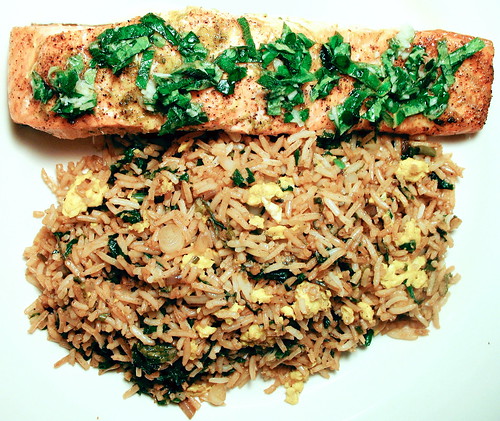
salmon with key lime and pineapple sage gremolata + ramp and sorrel fried rice

My suggestion: fried rice with ramps and sorrel next to roasted salmon with key lime and pineapple sage gremolata. This was a late (11 PM-ish) dinner at the end of a tiring and hungry-making day and it really hit the spot. I wanted nothing more / nothing less than a pile of protein and carbs and this was an appealingly fast and easy pile to make. Better still, the bright, citrusy flavors made it all feel light and vibrant and a bit celebratory, which was particularly welcome considering that the friend who came over to have a late dinner with me had just bought a very cool Vespa and couldn't wait to zip around on it.

Manhattan-20120512-01612
new (used)!

I hope it doesn't seem high-handed to suggest throwing sorrel into your fried rice. I love its tart flavor and would be happy to encounter it anywhere and everywhere while it's in season, but it can be frighteningly expensive to buy (and maddening to find) if you don't grow it yourself. Having never grown it myself, I've never felt that I've been able to eat my fill of it. In NYC this year it's about $10/pound. I tend to buy a little bag or box of it whenever I see it and just use it however I see fit rather than coming home with a mound of it and looking for a recipe for $40 sorrel soup or whatever.

You need to have cold rice to make the fried rice with. Everyone says so. Here, for example. I've never bothered trying to make it with freshly-cooked rice so I can't be contrarian. It makes sense, anyhow, that the texture would be all wrong that way, that the rice would end up overcooked rather than heated through.

Neither of these recipes depend on precision, which is good because you probably don't just happen to have a pineapple sage plant in need of a haircut. It feels a bit wrong even calling them "recipes" because both were incredibly simple and straightforward to prepare. They're more assemblages.  Use them as guidelines and let me know how it goes if you try something(s) else. Both serve two people.

fried rice with ramps and sorrel

peanut oil
a bundle of ramps, sliced into ribbons — keep the bulb-ends and the green parts in separate piles for cooking
a good handful or two of sorrel, sliced into ribbons (hopefully around 1 cup)
1 egg, beaten
enough cold cooked long-grain rice to feed you and your friend
salt, pepper, soy sauce

Heat a couple tablespoons of oil in a wok or heavy skillet over medium-high heat and sauté the bulb ends of the ramps until they start to soften. Add the green parts and cook for another minute or two. Add the rice and give it a good stir, making sure it's evenly coated with oil. Let it cook for a few minutes, stirring every so often. When the rice seems to be heated through and you're just about ready to eat, stir in the sorrel — it will wilt right away — and push the rice to the edges of the pan, clearing a space in the middle to cook your egg. Add a bit more oil if desired, and quickly cook the egg while stirring to break it up. Stir the rice over it, stir a few dashes of soy sauce into the rice, and stir everything some more to combine all the ingredients. Serve right away while nice and hot.
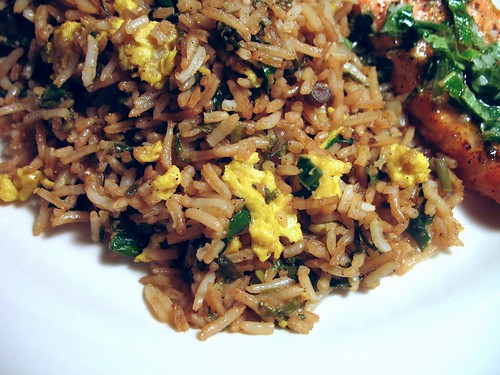
ramp and sorrel fried rice

roasted salmon with key lime and pineapple sage gremolata

Note: Do not substitute regular sage for the pineapple sage because it has a completely different flavor and strength. If you need a substitute try a mixture of parsley and thyme instead (and omit the additional thyme).

2 salmon fillets
5 or 6 key limes (or 2 regular limes)
2 to 3 tablespoons fresh pineapple sage leaves, sliced into ribbons
2 to 3 teaspoons thyme leaves
2 cloves garlic, finely minced
olive oil, salt and pepper

An hour or so before you want to eat, pat the salmon dry, season it with salt and fresh ground pepper, and zest a key lime over each piece. (The zest of one regular lime over both pieces should be plenty if that's what you're using).

When you're ready to eat, take the salmon out of the refrigerator and let it come down in temperature while you heat the oven to 425°F. 

While the oven is heating, zest and juice your remaining key limes over a bowl. (Use the juice from the two you denuded earlier). Stir in a couple tablespoons of olive oil, the garlic, the herbs, and a bit of salt and pepper to taste. Don't worry about it not emulsifying because you're making a gremolata rather than a vinaigrette. Which means that as soon as it tastes good, you're done and can set it aside.

Roast the fish on a lightly oiled baking sheet according to the ten-minutes-per-inch-of-thickness rule. When it's done, spoon the gremolata on top.

Wednesday, April 15, 2009

Rainy Day Snails #12 & 35

In which I resume my occasional series of reviews of out-of-print cookbooks:

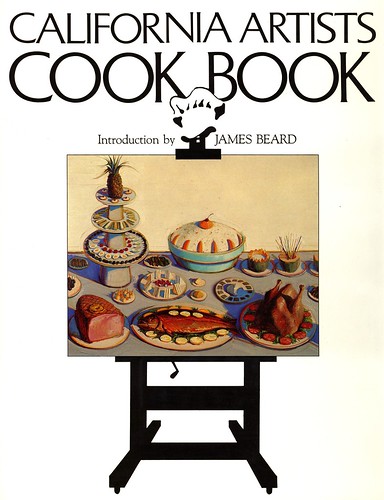
California Artists Cookbook

California Artists Cookbook
produced by Chotsie Blank and Ann Seymour
for the San Francisco Museum of Modern Art
(Abbeville Press, 1982).

I bought this because I wanted to see the Wayne Thiebauds in it. I've loved his work since I first encountered it at the Wadsworth Atheneum as a tiny kid on field trips. Although the images in this book are not of high quality (they scan nicer than they are in print) they're still fun to look at.

Wayne Thiebaud. Cakes and a Counter. 1962.
Wayne Thiebaud, Cakes and a Counter, 1963.

At the time of publication this one was apparently in Thiebaud's own collection, but now it's at the National Gallery of Art in Washington.


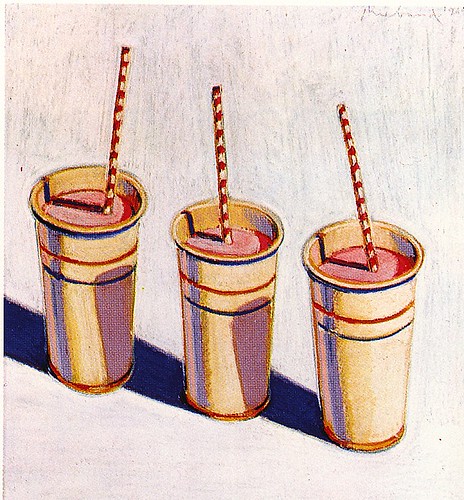
Wayne Thiebaud. Three Strawberry Shakes. 1964.
Wayne Thiebaud, Three Strawberry Shakes, 1964. Contributed to the book courtesy Charles Campbell Gallery, San Francisco.


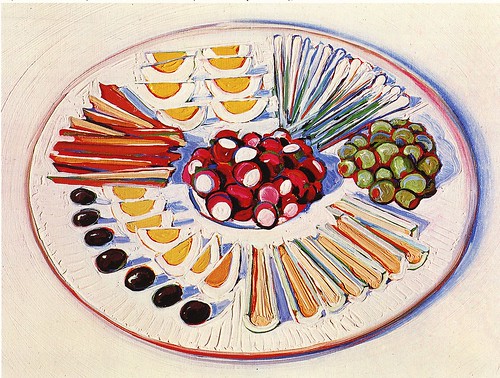
Wayne Thiebaud. Plate of Hors d'oeuvres. 1963.
Wayne Thiebaud, Plate of Hors d'oeuvres, 1963. Contributed to the book courtesy Charles Campbell Gallery, San Francisco.


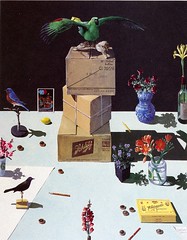
There's lots of other great art in the book. This painting by Paul Wonner is probably my favorite:

Paul Wonner. Dutch Still-life with Stuffed Birds and Chocolates. 1981.

Paul Wonner, Dutch Still-life with Stuffed Birds and Chocolates, 1981. Contributed to the book courtesy John Berggruen Gallery, San Francisco.

The carnivorous among you (and a certain portion of the anti-carnivorous?) may prefer Marianne Boers's still-life with Safeway meats:

Marianne Boers. Safeway Meats. 1973.
Marianne Boers, Safeway Meats, 1973. Contributed to the book courtesy John Berggruen Gallery, San Francisco.

Her "Royal Baking Powder" (which is not in the book) is a similar work of supermarket photorealism but dark and metallic rather than pastel and fleshy.

There are also over 200 recipes, and they are far more interesting than the type usually found in let's-collect-recipes-from-friends cookbooks. I didn't spot any that appeared to have been lifted from the back of a bag or the side of a can, and a great many of them are inventive and unusual. You are not likely to be served painter Penelope Fried's preparation of mangoes for reflective moments, for example, by anyone but Penelope Fried:

click here to enlarge the recipe and start being reflective

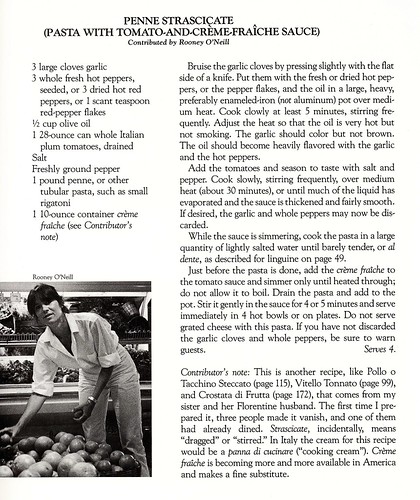
I flagged quite a few recipes I wanted to try. Painter Rooney O'Neill's recipe for penne strascicate appealed to me right away because of its simplicity and reliance on well-chosen ingredients. I also liked her admonition not to serve grated cheese with the dish; it's a sign that the recipe did in fact come from a good, strict Italian cook who is confident in their way with pasta and won't stand for any interference with the flavors they intend it to have.

click here to enlarge the recipe, though you won't be able to see down the painter's blouse


penne strascicate

I am happy to report that the recipe is indeed a keeper; the acidic canned plum tomatoes and the crème fraîche come together beautifully. I used only 1/4 cup of olive oil because I thought any more than that would just end up in little puddles around the edges of the pan. I was also a little concerned the tomatoes wouldn't break down enough while the sauce was cooking so I took a wooden spoon to the most stubborn ones as they simmered, and by the end of the 30 minutes I had a very nice sauce — fresh-tasting and just rich enough — that didn't need to be puréed.

Gerald Gooch's recipe for creamy sunflower dressing turned me into the sort of hippie who goes and buys a bottle of Bragg's Aminos (not to be confused with Dr. Bronner's, although both have word-soup packaging). There must be some sort gateway hippie substance among the aminos because I am now also happily drinking a little of their apple cider vinegar every day.

click here to enlarge the recipe if you're wearing socks with your sandals


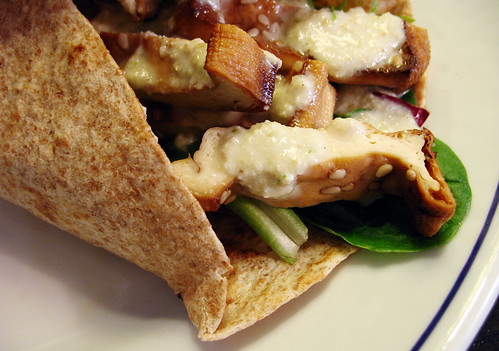
tofu wrap with creamy sunflower dressing 3

This dressing is GOOD. It's creamy and tangy and the flavor is really well-balanced. In the photo above it was used in a baked tofu wrap; it was terrific on simple green salads too. I was suspicious of the recipe because of the water content and because it doesn't call for much in the way of spices, but I am definitely going to be making it again often. Maybe it's the serotonin produced by the sprouts talking, but I think this dressing is good enough to please even people who claim to hate hippie health-food-store type foods. And possibly even children, though I don't have any to test it on. I didn't even use all the oil the recipe calls for (I ran out after 1 1/3 cups) and it was still delicious. I also had no parsley so I used celery leaves instead, and that didn't hurt it at all. Note, however, that the recipe makes an enormous quantity of dressing, so you might want to try halving it, or inviting all the local beard-wearers and spinners of lumpen pottery over to share it with you.

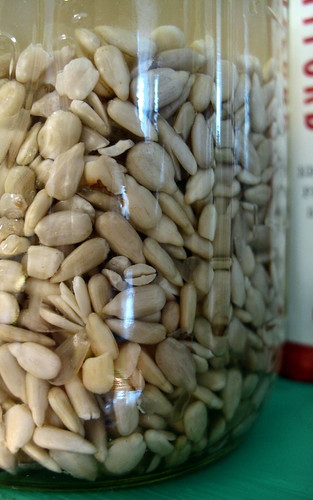
You can buy sprouted sunflower seeds at many health food stores but us hippies like to sprout our own.

soaking sunflower seeds

I used these instructions and while my first batch didn't sprout nicely — a few seeds did but most were duds — the second batch was a success. I think the problem with the first batch was that I didn't drain them well enough, and I put them in the refrigerator too soon. I drained the second batch really, really well, washed and dried the jar, then returned the seeds to the jar and let them sprout in it overnight (in a relatively cool, dark place) before refrigerating them. I was so excited to see that I finally had home-grown sprouts that I forgot to take a photo before I used them in the dressing, but for your edification you should know that they won't get as long as alfalfa sprouts. Their tails are between 1/4" - 1/2" or so. I still don't have a sprouting lid for my glass jar but cheesecloth is fine  as a substitute.

Gooch's work is worth a look, by the way. There isn't a great deal of it on the internet but there's a sour-faced art critic I'm very fond of, and his Man with a Scarf diptych has its own charms. Here is the man himself posing in front of some palm trees (symbols of "all the pricks in the world").

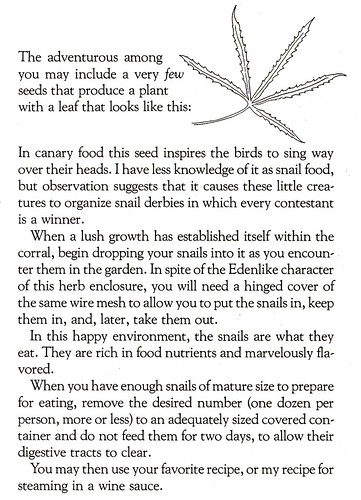
The most unusual recipe in the book is probably one for escargot à la Cheech and Chong, which includes detailed instructions for building a mesh enclosure to raise healthy snails in one's backyard, and some interesting suggestions on what to feed the captives:

click here to enlarge the image (unless you're a garden narc)

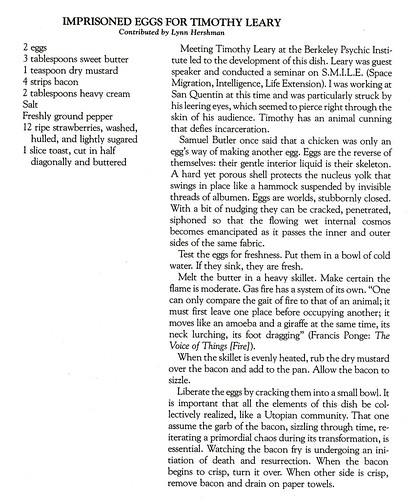
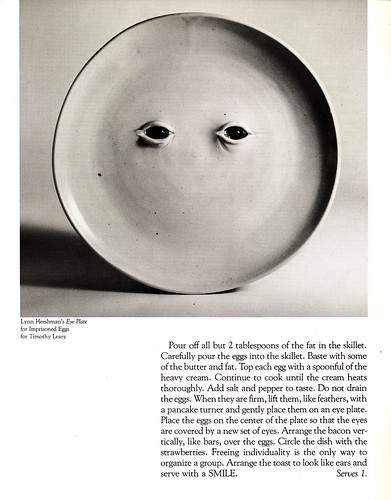
A very close second in the most-unusual category is a recipe called "Imprisoned Eggs for Timothy Leary," which is sort of an IHOP Funny Face for tuned-in adults:

click here to enlarge the recipe and get one step closer to the flowing wet internal cosmos

click here to enlarge the recipe and make eye contact with that plate

The timing is a little odd since Leary had already been released from prison at the time, but maybe cosmic emancipation happens when one is prepared for it to happen.

There's also an unusual recipe for a salmon barbecue buffet. The ingredients and method of preparation aren't very strange — two whole salmon, stuffed with a mixture of mushrooms, bread crumbs, crabmeat and fresh herbs and grilled over hot coals — but the recipe also calls for two small trout to be stuffed and cooked in the same manner as the salmon, and when everything is ready, the fish are to be arranged on large platters in a tableau mort, with the trout clasped in the salmons' mouths, and a cherry tomato in each trout's mouth. An impressive display certain to have any vegetarians at the party clutching their glass of wine just a little more tightly, if they've not already run off into a darkened bedroom to lie down for a while.

As a whole, though, the book features a nice mixture of appealing, very cookable recipes and curiosities that require special plates with eyeballs. Since these were California artists the use of fresh fruits and vegetables throughout the book is of particular interest, and I'd really like to try the loquat pie, persimmon pudding, cold yogurt soup with cucumber, mint and walnuts, and Ansel Adams's sorrel soup. The dessert chapter is by far the most extensive (37 recipes) but the meat and fish chapters are a very close second and third. Abstract expressionists are apparently fond of brooding over long-simmering stews and sauces: oxtail ragout, rabbit braised with rosemary, beef tenderloin Bordelaise.
As for the introduction by James Beard, it was surely a coup for the Museum's Modern Art Council to get him to write it, but unless you are a huge fan of him it's probably not of much interest. It was just a few years before he died and there's a very unflattering photo of him looking jolly and liver-spotted; he made a few interesting points about the importance of having "an aesthetic appreciation of what one sees and eats," but it's a brief introduction and this theme is not developed in great detail.

If you think you might like to buy the book, it is available through my bookshop cheap as chips.

-----------------------------

Previous posts in this series:

New York Entertains by the Junior League of the City of New York

The Single Girl's Cookbook by Helen Gurley Brown

Eggs I Have Known by Corinne Griffith and Cookbook in Solidarity With the Symbionese Liberation Army by Mona Bazaar