all the latest news about emotional container gardening
I've been reading The Château de Résenlieu by Lord Berners on the train this week, having picked it up on impulse at the Cabinet magazine book sale, and in it Berners describes the proprietress of an unusual garden he encountered one summer in Normandy:
Madame O'Kerrins did not have much intercourse with the inhabitants of Gacé. There was one old lady who visited the Château fairly frequently. Her name was Madame Bonnet and she lived in a large, ugly house near the church. In her garden there grew the largest begonias I had ever seen. Madame Bonnet told me that their size and their beauty were due to their being manured by the corpses of cats. In the bedding out season she used to offer a small reward to anyone who brought her a dead cat and when a sufficient number had been collected they were used as a foundation for the begonia beds. It seemed to me a rather macabre idea and I thought that at night the garden must be haunted by the ghosts of cats miaowing and caterwauling. These flowers were in a way symbolical of Madame Bonnet herself.
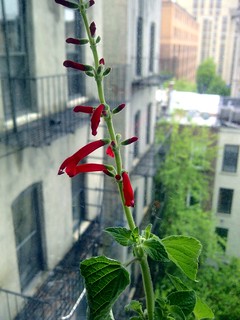
I'm not likely to take Madame Bonnet's gardening methods as instructive, but on an intuitive level it makes perfect sense to me that all gardens reflect something of the character of their gardener. My container garden just now is wallowing in indolence. My Alpine strawberry plants stopped producing fruit not long after my last update, and with them a great deal of heart went out of my gardening. (It should be fairly obvious that when I characterized myself as "a highly emotional gardener but not a sentimental one," I was making a perverse little joke. Look up "sentimental" in the wonderful iPad dictionary and there's probably a link to this blog, along with an embarrassingly accurate illustrated cross-section of my innards, sliced into translucent ribbons by sentiment.) My pepper plants have been exiled but continue to torment me with their incomprehensible refusal to set fruit — more about this below — and my pineapple sage dropped dead for no apparent reason, after ailing for just a few confusing days. Unless it was an act of performance art, in which case its death was an effective commentary on the dark moods that have discomposed much of my summer. It may indeed have been; in conducting my postmortem I discovered, somewhat disturbingly, "[o]ne superstition was that the plant would thrive or wither according to its owner’s fortune." I prefer to think a nutriment deficiency was to blame, but doom seems to have no shame in being heavy-handed when it comes to call.
My Sorrento lemon tree seedlings, at least, are thriving. All of them, which is a lot! I re-potted them with an abundance of caution and expected to lose at least a few, but not one has died, drooped, or taken on a sickly color. Perhaps they've been buoyed by their early fame — my photos of them in their infancy will appear in a video about citrus produced by the University of Wisconsin-Madison's Plant Breeding and Plant Genetics program, like these.
I have six pots of baby Sorrento lemon trees at present, scattered all over my apartment, of which the one below is representative. When I re-potted them I was reluctant to try separating the embryonic seedlings from the apomictic ones — I explained a bit about those here — and now that they need re-potting again, I find myself once again skittish about interfering with the mysterious relationships they have amongst themselves. I'm going to keep them together, since they appear to be getting along nicely, while presuming that at some point in their adolescence a dominant tree will take over each pot. If you're in the NYC area and would like to adopt a pot, email me; I wouldn't mind giving one or two away to a good home (i.e., to someone who doesn't look like a plant-murderer). They currently live on south-facing windowsills and don't seem to require any special care beyond the good light they're getting. I'm going to give them bigger pots this weekend, and probably some citrus fertilizer. They've done fine without it so far, but after seeing how my pepper plants responded to feeding I don't feel good about starving the others.
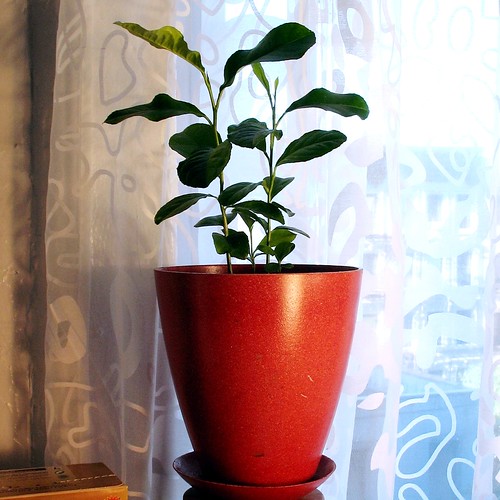
Baby Sorrento lemon trees started from seed, approximately three months old.

I wear my garden on my sleeve: my favorite swimsuit this summer.
Additional good news: I finally got my pineapple act together and my pineapple plant looks happy. I've written about my desire to grow a pineapple several times (here, for example), but I kept leaving the requisite pineapple parts on top of my refrigerator too long, intending to let them dry out for a couple days but forgetting to plant them before dessication set in. The instructions are very simple; basically you trim the crown and put it in a pot. Voilà, in a couple years or so, a home-grown pineapple. Bob Flowerdew of Gardeners' Question Time promises this:
I guarantee if you keep it warm and misted daily in summer and dry as a bone from autumn through to late spring, you will be rewarded with a spectacular flower and then a sweet, sparkling fruit. If you do a good job, you will get a fruit as big as a baby; if you do a bad job, you'll only have enough for a pineapple chunk or two. But that's gardening for you . . .
My apartment gets ridiculously dry in the winter months and I have high hopes that my pineapple will be the size of a very chubby baby. I've been bad about misting it, but writing these updates tends to get my gardening back on track, and in the meantime it doesn't appear to have suffered from my laziness. The instructions I linked to above say it's normal for the original leaves from the crown to die off, and the new growth in the center of my plant looks healthy. I started with an organic pineapple, by the way, and I think you should too. Conventionally-grown pineapples are drenched in creepy pesticides.

My pineapple plant. It's supposed to have brown bits round the edges;
that's the old crown dying off. Good riddance!
In related long-range container gardening news, my avocado tree got re-potted and looks happier than ever, though a bit droopy on the morning I photographed it. A good watering enlivens it. I started it from seed approximately three years ago, from a particularly delicious Haas avocado. Very clever of it to have decided to get bushier rather than taller after having reached the top of the window, don't you think? I don't happen to have any photos of it when it was younger, but it used to be just a single, spindly trunk. The smaller, second trunk appeared this spring, I think, and after I gave it a badly-needed new pot the whole plant became fluffier with new horizontal growth.


my avocado tree
As for my chile pepper plants, they have indeed been given the heave-ho, as I was contemplating in my last container gardening update, though I still see them regularly and will probably repossess them at some point. Rather than putting them out on the sidewalk I gave them to a close friend who had a bare windowsill and didn't mind filling it with non-productive greenery. They were already pissing me off, those plants, and soon after I last blogged about them things took a turn for the worse. (There was also a matter of needing to make room for an air conditioner in one window, but I could've chosen other plants to get rid of; my extremely boring Sansevierias had previously been at the top of my shit list). I gave my sulking pepper plants bigger pots and worm castings — nutritious turds, reportedly beloved by all plants — and still nothing. What the hell else did they want from me? It finally occurred to me that the reason they weren't setting fruit was that they just weren't getting pollinated. In my mind putting them on the fire escape had taken responsibility for this out of my hands, but a bit of research revealed that rocotos in particular are often unattractive to insects:
PLANTS MAKE FLOWERS BUT NO FRUIT? Most hot peppers and some sweet peppers require insect pollination to form fruit. If the proper insect is absent, or if the local insects are not attracted to your pepper flowers, you may see the plants flower, drop off and never set fruit. This is especially true for the blue-flowered Capsicum pubescens, the Manzanos or Rocotos, or hot peppers grown in a greenhouse.
Pollen is produced on the stamens by the anthers, and usually ripens between noon and 3 PM every day.
To hand pollinate, take a moistened water-color paint brush, and pick up some pollen on your brush and transfer it to the other flower centers. You can get close to 100% fruit set with hand pollination.
- Pepper growing tips from Redwood City Seed Co.
I'd read about hand pollination before, but there was never any mention of moistening the brush. A dazzling eye-opener for the novice gardener who was doing it all wrong! I diligently diddled their flowers every day. After about a week of this, during which time the plants were indoors on my windowsill rather than languishing on the fire escape, where none of the sexy insects passing by would give them the time of day, the ungrateful little bastards not only didn't fruit, they stopped flowering too.
I considered adding some companion plants to their pots before giving them to my friend. When I planted the borage on my fire escape I inadvertently learned a bit about this because borage is said to be good for everything it grows near. I looked at a list of companion plants but it was of little use; it indicates that tomatoes are good for peppers because their height helps to keep the humidity level high, but NYC this summer has already been plenty humid. And do you know what plants peppers help? Themselves, and marjoram. Themselves! For fuck's sake. It was then that I really started to wonder whether my particular pepper plants don't simply have a neurotic need for a certain kind of attention. Their reluctance to set fruit or even produce flowers despite appearing healthy and being well-cared for made me wonder if they weren't the plant equivalents of One Of Those Guys. You know, one of those guys who has mostly women friends and as a result seems cool with being equals? Then you get to know him better and a pattern emerges whereby it becomes apparent that they're all flattering him or making him feel important in some grossly retrograde manner reminiscent of a Victorian novel? I'd started to feel that that's what my plants wanted, endless bullshit flattery. "Oh you poor dears, let me get my little brush, just like I did yesterday, and the day before that!" Etc. It wasn't something I felt willing or even able to do, and that is why they're no longer living on my windowsill.
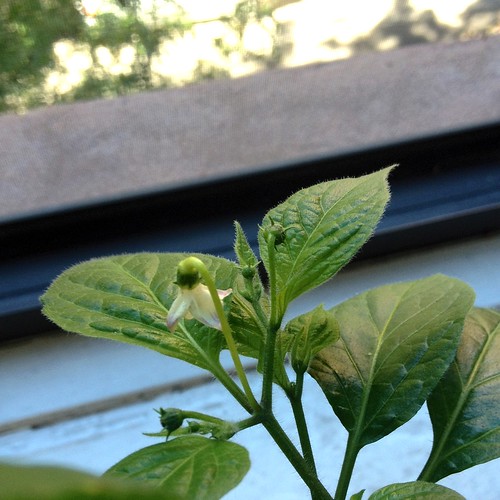
An important clue emerged shortly after they went to go live on my friend's windowsill, however, and I think I maybe had them figured wrong. I also cautiously think they might finally be on the mend. (A thought I've had before, but this time feels more for-real). What happened was that they started dropping leaves. Naturally my friend thought they'd taken an instant disliking to him, but I was grateful to see them finally articulate a little something about their health. Apart from their reluctance to set fruit, it was the first clear sign that they were not in fact as healthy as I thought they looked. And it told me enough to fix them up with what they needed, I hope: dropping leaves was a big hint that they weren't getting enough nitrogen. Tomato fertilizer is particularly high in this, so I went to my friend's place to mix up some organic (but pink!) tomato stuff in his kitchen. The plants showed immediate improvement. Their maddeningly aloof habit of appearing healthy while not doing any of the things I want them to do has historically brought out the very worst in me as a gardener, but here, finally, was something I could notice and respond to and, gratifyingly, see results from. Not only did they not drop any more leaves, they started growing lots and lots of new ones the very next day. One more day and they were flowering again. My friend — who has only ever kept cacti, which do just fine with neglect — was mystified by their responsiveness and has come to regard the pink water as having magical properties, and the plants as "a mysterious bunch." He reports that he is diddling the resulting flowers with great enthusiasm (being a watercolor painter, he's got plenty of brushes for this), and once a week or so I go downtown and diddle them myself. I don't believe any have set fruit yet, but surely at least one will finally cooperate? At this point one pepper would mean a lot to me.

My borage plants did everything they were supposed to do but have nonetheless been a disappointment to me. The leaves have a fishy taste! I think it's got to be coming from the modest amount of fertilizer I buried in their planter before sowing the seeds. Fish meal is a common ingredient in organic fertilizers (and possibly even in the organic soil I used?), and fishiness apparently ruins the delicate, cucumber-y taste of borage. I had so many plans for my borage leaves: muddling them in drinks, pickling them with golden beets, flavoring an ice cream studded with bits of diced, candied cucumber. Hmph. I probably ought to at least use them to wrap some salmon while it's curing, rather than letting them grow monstrous out there on the fire escape. I've got lovage in the same planter but it's not really ready to use yet, and I've held off on tasting it for fear it's fishy too. I'm hopeful that when mature it will have sufficiently strong flavor to knock out the fishiness. Lovage is a heavyweight and this seems reasonable to me.
lots of new flowers and new leaves, and
maybe a nascent pepper forming in the center-right?
maybe a nascent pepper forming in the center-right?

The cover of Sunset magazine, Sept. 1904, featured a woman drying her
pepper harvest. I doubt I'll have as many. Image from the NYPL digital gallery.
My borage plants did everything they were supposed to do but have nonetheless been a disappointment to me. The leaves have a fishy taste! I think it's got to be coming from the modest amount of fertilizer I buried in their planter before sowing the seeds. Fish meal is a common ingredient in organic fertilizers (and possibly even in the organic soil I used?), and fishiness apparently ruins the delicate, cucumber-y taste of borage. I had so many plans for my borage leaves: muddling them in drinks, pickling them with golden beets, flavoring an ice cream studded with bits of diced, candied cucumber. Hmph. I probably ought to at least use them to wrap some salmon while it's curing, rather than letting them grow monstrous out there on the fire escape. I've got lovage in the same planter but it's not really ready to use yet, and I've held off on tasting it for fear it's fishy too. I'm hopeful that when mature it will have sufficiently strong flavor to knock out the fishiness. Lovage is a heavyweight and this seems reasonable to me.
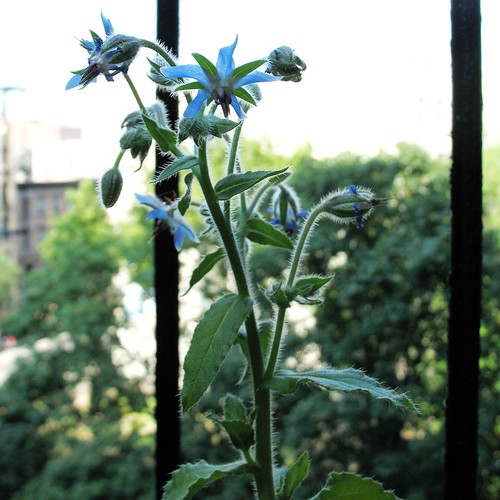
borage flowers on my fire escape
Notwithstanding all the problems I've run into, I have a lot of hope about carrying on with my emotional gardening next summer. I'm planning to take a community garden plot to increase my Alpine strawberry holdings, and there are some encouraging signs that I'm not the only emotional gardener in the neighborhood. Far from it — there's a guy on West 105th St. who is sticking it to his landlord with a very impressive "mother garden," and at our nearest garden center there are people dancing the tango.
Previous posts about my container gardening are here, here and here.