* I'm an idiot and accidentally deleted my May 2102 post on 'relentlessly emotional container gardening' while trying to update the link for the Jesus & Mary Chain video embedded below. The Blogger platform did save a draft of it, though, and I think it's a good read for all the weirdo gardeners out there, so I'm reposting it (more or less) as it was.
yours in springtime,
Madeleine
April 2016
yours in springtime,
Madeleine
April 2016
*****
Again? Yes because my last post on this subject focused on the stuff I've grown to date and this one's about what I'd like to grow. It's a long list but many of these plants are for next year. I've been quite restrained about my plant ambitions lately. Yes really! My apartment faces south and I get good light, but with the recent addition of a large pot of cinnamon basil and the seed germination projects described below I've run out of window sill and fire escape space. I have hanging plants too but I can't have too many of those, and I nearly have too many of those now.

from World of Interiors July 2011. It's been in its location
in the Bolhão market since 1921. See more photos here.
- Pineapple grown from old pineapple parts. I mentioned this a couple weeks ago. I've tried it before, a couple times actually, but things kept happening, things that distracted me during the crucial stage of planting the pineapple parts after they've dried out a bit and before they've dried out too much. This is entirely my fault and not an inherent difficulty; the instructions for growing "a healthy, attractive pineapple for your home" couldn't be simpler. I'm going to make another attempt. I only want to use organic pineapples for growing (and for recipes that use the peel, like making tepache) and they're kind of hard to come by. If you live in NYC, Fresh Direct has a reliable supply of them. Commodities on 1st Ave. next to Momofuku has them too sometimes.1
- Oyster leaf (mertensia maritima), as shown looking totally fascinating here. This is a plant that grows wild in the Hebrides and reportedly has a briny, oyster-like flavor. It is of great interest to my semi-secret subcommittee for the development of oceanographic snacks, which has become curious about the idea of icy cold oyster-y lemonade accompanying an elaborate beach-going packed lunch.
- Radishes. I understand they grow quickly and without torment to the gardener, and I love them fresh, pickled, or in a soup. I'm starting two varieties from seed right now: Jaune D’Or Ovale Radish, a French heirloom variety, and German Giant Radish ("I think it has just the right amount of spice to it, perfect for eating with salt & a beer," says a reviewer I'd like to have a beer with). I've got another variety of seed on hand, Chinese Green Luobo, but the instructions say to start them nearer to autumn because they only grow well in cool weather. (Summer has barely arrived and already I'm thinking about how nice it will be when I need to put on a woolly sweater for my fire escape radish-harvesting . . .). Radish sprouts are delicious and beautiful but I think they need to be germinated from a different type of seed (e.g.). I'm not growing them right now because I don't want to go apeshit with the whole radish thing.
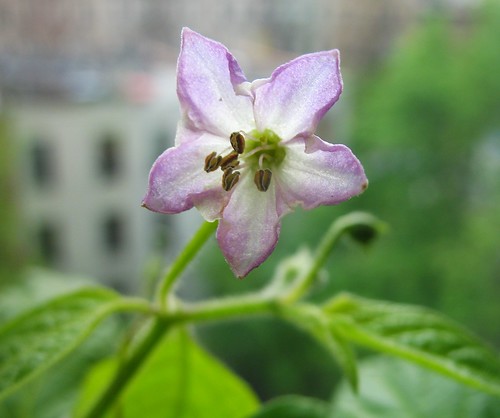
- More chili peppers. Now that I've put my foot down on the obstinate (at times, truculent) mismanagement of my pepper plants I'm kind of excited about growing more varieties. On my wish list to start very early next spring: Tunisian Baklouti (I don't think I have ever met a Tunisian foodstuff I didn't like); Shishito (a favorite for eating grilled or broiled, but sometimes expensive and less-than-perfectly-fresh when bought in Japanese groceries); Bulgarian carrot peppers (bright orange, fruity and hot); Pequin peppers (my favorite store-bought dried pepper flakes are Pequin and I'd love to try them fresh); and Black Hungarian peppers (attractive little things with reportedly very good flavor, and interestingly they sound as temperamental as actual Hungarians, which I partially am so I can say that). I've also been eyeing these lumpy, pendulous, purple Cajamarcas, "a beautiful fruit that begins a vibrant violet unique to C. chinense and then changes to a rich red. The wonderfully fragrant aroma of ‘Cajamarca’ captures your attention with an intense, spicy-citrus fragrance and the classic habanero fruity undertone. Very Hot," according to The Chile Pepper Institute, which is selling the seeds.

Cajamarcas from The Chile Pepper Institute
- Black sesame. Is it madness or genius to grow yr own sesame seeds? I can see something going terribly wrong at the harvesting stage in particular. Like, a strong gust of wind. But I love, love the flavor of black sesame in both sweet and savory dishes and I'm not likely to have a chance to taste their leaves unless I grow my own, am I?
- Cucumbers. I'm so intrigued by these brown Russian cucumbers ("hands down the best tasting cucumber I have ever tasted" says the seed store cucumber-eater) and these bright green Parisian Pickle (Improved Bourbonne) ones, but sadly I don't think cucumbers are a good container crop. I'd only give them a try if I had more space for bigger containers. Do you have such a space and would you like to experiment with Skype gardening? I would provide advice and instruction in my uniquely dissolute lo-fi gardening technique and you would send the cucumbers. Think about it.
- Osmanthus. I bought a jar of sweet osmanthus sauce in Flushing on impulse a couple years ago and have been crazy about its sweet, salty, floral flavor ever since. I'd love to have a supply of fresh osmanthus flowers for experimenting with. TopTropicals.com says "it is a slow growing medium size shrub or smaller tree that can easily be kept in container as a compact plant for years. You can create your own little Fragrant Valley . . ." I'm out of window sill space but if I can get a suitably large hanging pot I'll try that. I couldn't help but notice the same seller also carries something called Popcorn Cassia, which "smells like fresh cooked, buttered popcorn when you run your fingers through the leaves" but has "the distinct scent of peanut butter" when flowering, but it's a shrub and there's no more room on the fire escape for one of those.

sweet osmanthus sauce

osmanthus flowers
- Borage. Little blue flowers with a nice cucumber-ish flavor, and bees like them too so it's a good plant for the whole gardening area. Borage has been on my mind since I found some atop a memorably beautiful and delicious plate of sashimi I ate last summer. (I didn't feel a need to snap a photo until after I'd eaten the most beautiful parts, sorry). I'm starting some from seed now.


Innocent Beauty borage from Kensitas Flowers
(1930s cigarette cards) from the NYPL.
- Mint. A must-have for people who like the way it tastes, or who have people over for drinks. I didn't think I had any more room for plants but I brought home some Swiss mint anyhow — chosen from the Stannard Farm stand at Tompkins Square Park greenmarket for its clean, icy smell and taste — and created a spot for it in The Hanging Mint Garden of Harlem. (A big, light-weight hanging planter with a built-in drainage system, found at Saifee Hardware).
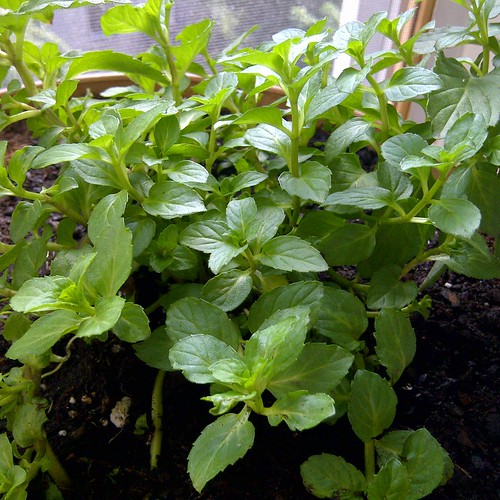
my Swiss mint
- Lovage. I've been banging on about how much I love lovage for a while now. Sadly my efforts to grow it at home haven't worked out for me in the past. The plants I've brought home have withered in the sun before I could even manage to re-pot them. In hindsight I think it was a combination of neglect and . . . honestly it was probably all neglect. I'm trying again and this time I'm starting my lovage from seed. By the way, my borage and my lovage live in the same bag planter. (I've read that lovage improves the health of everything it grows with so I'm not worried about the borage). I thought those planters were a great find because they're only $15 and they're very light in weight. I'm using them to grow the radishes too, and some secret salad greens I'll show you another time.
- Purple tomatillos. I keep missing the window for starting these. They're meant to be started six to eight weeks before the last frost. Next year, etc.

organic purple tomatillo seeds
from Etsy seller cubits
- Sorrento lemons. I mentioned Sorrento lemons recently and I was very sad when Manhattan Fruit Exchange said they didn't have any more and weren't sure when they'd get them again. They're a special variety grown on the Amalfi coast and the ones I bought had such a beautifully bright and true lemon flavor. I've loved lemons all my life, ordinary grocery store lemons, but I don't want to go back to them after having tried these. I want to say they were perfectly tart without being acidic but that would probably sound strange. Anyhow, I saved all the seeds I could (which wasn't many because they had relatively few) and ended up with eight or nine to try to germinate. Unfortunately I'd already planted them according to these instructions when I discovered that other people recommend peeling the seeds first, but I remained hopeful, and for at least two weeks I gazed at their little pot daily with tremendous concentration and affection. I got so impatient that I considered gently exhuming and peeling them, but then I found one more Sorrento lemon in the bottom of my refrigerator, elderly and denuded of its peel, and got an additional four seeds from it. I peeled them carefully as per the new germination regime and tucked them away under a layer of damp paper towels, and covered their plate tightly with plastic wrap. The exciting news is that after one more week of waiting, an exceptionally humid week here in NYC, both batches of seeds have sprouts! I'm going to give them a little more time, and if more of them succeed I'll seek a good home for the seedlings here on my blog and on the food bloggers' mailing list. For now I'm going to keep making encouraging eyes at what I've got. I'm not sure if anyone else would want them anyhow. Trying to grow Sorrento lemons in Harlem is right down the narrow, bat shit-splattered alley where my container gardening takes place.
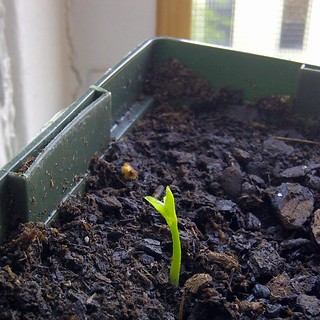


my Sorrento lemon seeds sprouting
________________________
1. For the record, I take exception to that link's description of the "fairly large selection of organic, freshly-spritzed vegetables and unbruised fruit" at Commodities; it's expanded over the years and they now have a large selection, period. I've bought all kinds of great produce there, things like fresh tumeric root and little red bananas and seasonal oddities such as ramps and fiddleheads.