Wednesday, April 11, 2007

Things I may not necessarily have told a dinner guest

First, our dinner was still wearing its face when I brought it home.

rainbow trout

That's Edwina on the left, and her friend Carl on the right, being shy.

Their heads (and tails) had to come off before they could fit in my skillet, and these were the very first beheadings in the Tiny Banquet Kitchen. I am pleased to announce that it all happened swiftly thanks to Forschner Victorinox, and there was no jeering.

Second, the reason why the potatoes were so good was that I roasted them in duck fat. Quack, quack. According to the people at D'Artagnan it is "nutritionally similar to olive oil," but it sounds like a fattier fat, doesn't it?

roasted potatoes

Fingerling potatoes with a few shreds of sage.

We ate the trout with a hazelnut and mushroom stuffing from Madeleine Kamman's
Savoie: The Land, People, and Food of the French Alps. I was going to hold off on writing about this recipe until autumn because it seems . . . autumnal, but we're still wearing heavy coats and occasionally seeing snow flurries here so I guess now is as good a time as any.

hazelnut-stuffed trout

The stuffing works well with the subtly sweet flavor of the trout, and the crisp skin is so delicious that we ate everything but the wee little fins. If you try the recipe (below), do not be tempted to skip the step of clarifying the butter; you need it for this recipe because regular butter would start to smoke before it got hot enough to sauté the fish, and the flavor of olive oil wouldn't work as well with the hazelnuts. There are good instructions on how to clarify butter here if you need them. The butter will make loud cracking noises while it heats, and as with popcorn, the noise will helpfully slow down all of a sudden to let you know that it's time to take the pan off the heat.

The bread crumbs are easiest to make by chopping a few small chunks of baguette in the food processor, but you only need a couple tablespoons of crumbs so you could instead just tear the bread into very small pieces with your hands.

As for the hazelnuts, the easiest way to remove their skin is to gather them in the center of a clean dish towel as soon as they've finished toasting in the oven. (
350°F for 15 minutes). Rub the little bundle between your hands as briskly as you can. This should remove most of the skin; scoop up the nuts, shake out the towel, and if necessary, repeat the process while the nuts are still warm to remove the rest. If you are a city dweller without a backyard, shake your hazelnut-skinning towel out the bathroom window, into the airshaft; the skins are perfectly biodegradable and might make a nice nest for whatever little creatures live down there.

I've lightly edited the recipe instructions for clarity; the admonition at the end is Kamman's. I made the full quantity of stuffing although I had only 2 trout to stuff; the leftover stuffing can be baked in mushroom caps the next day, or it can be the filling for an omelet.

Hazelnut-stuffed trout
Truite Farcie aux Noiettes

6 trout, cleaned and boned, or 1 larger fish (to serve 6)
2 tablespoons butter
1 shallot, finely chopped
1/2 pound mushrooms, finely chopped
2 tablespoons fresh bread crumbs
2 cloves garlic, finely chopped
2 tablespoons chopped parsley
1/3 cup peeled, toasted hazelnuts, finely chopped
2-3 tablespoons heavy cream
Salt and freshly ground pepper
All-purpose flour (enough to flour the fish)
1/2 cup clarified butter

Heat the two tablespoons of butter in a skillet and s
auté the shallot and mushrooms until the mushrooms start to release their liquid. Add the bread crumbs, garlic, parsley, hazelnuts and heavy cream and season to taste with salt and pepper.

Let the stuffing cool in a bowl and wipe the skillet clean. When the stuffing has cooled, use an equal amount to stuff the cavity of each trout, or, if using a large fish, stuff the cavity with all of it. (If you've made the stuffing in advance and refrigerated it, let it come to room temperature before you stuff and fry the fish; otherwise it won't heat all the way through in the brief time it takes to cook the fish).

Lightly flour the fish and panfry it in the clarified butter for approximately 4 minutes per side, or until the skin is brown and crisp. If using a whole fish, broil it for approximately 6 minutes on each side. Serve plain, without any other sauce.

As for the accompanying potatoes, there is an interesting Nigella Lawson recipe involving goose fat and semolina here and a simpler BBC recipe here. It is far easier to find duck fat than goose fat and I've been using it to roast potatoes since I picked up one of those little D'Artagnan tubs; the flavor is very good and the fat seems to keep well in the freezer.

Sunday, April 08, 2007

I hope the bunny left something good
in your basket

Easter 1978

Easter, 1978. That's me on the left and my cousin on the right.


Here is a more-or-less healthy recipe for persons who may have over-indulged in chocolate bunnies, stale jelly beans, and Cadbury mini eggs.

let's eat some greens


Polenta with chickpeas and wilted chicory

medium-coarse polenta
2 small cloves of garlic or 1 large
2-3 shallots or 1 small onion
1 large jalapeño or other spicy chile pepper, seeds removed
2 tablespoons olive oil
1 can chickpeas, drained and rinsed under cold running water
1 large head of chicory (sometimes called curly endive), washed and torn into pieces
sea salt and freshly ground black pepper
freshly grated good-quality parmesan or pecorino romano

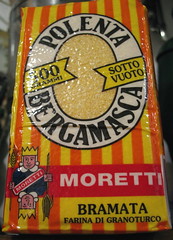
Prepare the polenta according to the instructions on the package. (I like this one in the striped bag with the little king on it; it cooks in about 15 minutes).

Mince the garlic, the shallots and the chile pepper.

Heat the olive oil in a medium- to large-size sauté pan until it's hot but not smoking. Add the garlic and the shallots and cook, stirring, until they soften and just begin to brown. Add the chile pepper and cook for another 30 seconds, or until it begins to soften. Add the chickpeas to the pan and cook until they are heated through and beginning to brown, 3 to 5 minutes. Then add the chicory to the pan in batches, stirring, until it's all wilted. Season to taste with salt and black pepper. Spoon the mixture over the polenta and top with the grated cheese.

Serves 2 to 3. Leftover greens and chickpeas are good in a toasted pita.

Note: If the chickpea-and-chicory mixure is finished cooking before the polenta, just keep it warm in a covered pan until needed; it doesn't need to be super-hot when you serve it.

Friday, April 06, 2007

mon sac à légumes

It's getting to be that time of year when I will be carrying great big bags of produce home from the farmers' market, so I was happy to find this adorable bag for sale for a very reasonable $13, VAT excluded.


I put it in my cart and voila, shipping to les États-Unis is FORTY NINE DOLLARS AND SEVENTY-FOUR CENTS. Incroyable! Does it come with un petite bag of l'herbe? I don't believe it does.

So, on to Manufactum, where I found a terrific bag woven of steel fibers:


Into my cart it went, along with a few irresistible notebooks just the right size for grocery lists. And then? The drop-down list of countries Manufactum ships to seems to stop at Sweden. No "United . . ." anything. Sigh.

Cute canvas totes are easy enough to find and work as well for men as they do for women — at least, here in Manhattan they're a good look for everyone; I can't speak for whether or not a man-tote would be acceptable in Boise — but they don't ever seem to hold as much as one thinks they might, and they tend to get dirty fast.

I've noticed this sort of cart for sale more and more often; I suppose it might be useful, but if you have that many mouths to feed, might one or two members of your brood be pressed into service to carry your heaviest bag of tomatoes and your most-unwieldy squashes? Your tomatoes would probably be squished in the pricey basket anyhow.

I'm just going to continue frumping up the markets for now with one of my half-dozen hippie string bags. Hopefully I will not continue losing them on a weekly basis, but in my experience they are harder to keep track of than socks or even teaspoons.

Tuesday, April 03, 2007

Committee stuffs its collective pie-hole with teeny tiny greens

micro celery!


Micro celery from Satur Farms, available at Fresh Direct (along with micro red amaranth, micro cilantro, and mixed micro greens). The world's tiniest celery has a strong and true celery flavor, but what do you do with it?

salmon with gremolata


We had little fluffy piles of it dressed lightly with olive oil and lemon juice alongside salmon with gremolata and mushrooms à la Grecque. If you are not familiar with the former, gremolata is basically a pesto made without cheese or nuts. Most recipes contain parsley and lemon zest and garlic; mint might stand in for part of the parsley and lime might take the place of lemon, and if the cook is unconcerned with tradition for tradition's sake there might also be capers in the mix. Wikipedia notes that gremolata is similar to persillade but only in the persillade entry will you see that both are similar to pistou.

The recipe for the salmon is here (scroll down) and I would happily make it again. I had just two salmon fillets but made the full quantity of gremolata; the left-overs can be put to excellent use, particularly if you reduce the amount of salt by half. You can always salt your salmon to taste at the table, but if you are stirring the remaining gremolata into risotto or scrambled eggs or spreading it on a sandwich or spooning it on top of a bowl of soup you won't want it too salty.

As for the mushrooms à la Grecque, I'd never made them before and when I began comparing recipes I soon realized that there is no definitive version. In all instances this is a dish of mushrooms cooked in olive oil, seasoned with coriander seeds, and served chilled, but the acidity might come from white wine or from lemon juice, and in addition to coriander there might be thyme or maybe some other herbs. There is usually chopped tomato or tomato paste, and possibly onion or shallots.

mushrooms  à la Grecque


I used both this recipe and this one and worked with what I had in the kitchen, which meant that I left out the tomatoes and the substitute tomato paste. My version instead used the following ingredients:

1/2 cup olive oil
1/2 cup white wine
1 generous teaspoon coriander seeds
1 sprig of thyme
1 fresh bay leaf
1/2 pound of white mushrooms, cleaned and cut in half or in quarters if large
salt and freshly ground pepper to taste

Bring the olive oil, the wine, the coriander seeds, the thyme and the bay leaf to a boil. Add the mushrooms and simmer for ten minutes, uncovered. Allow the mushrooms to cool in the liquid, season to taste with salt and pepper, and refrigerate both the mushrooms and the liquid in a covered dish until well chilled.

The mushrooms were very, very good and I have a feeling I am going to be making some variation on them every week during the summer, particularly with zucchini in place of the mushrooms. The flavorful liquid shouldn't go to waste; with a squeeze of lemon juice it makes a delicious salad dressing.

The left-over micro celery went into a sandwich, but it was no match for good ham and strong mustard. I think it's far better suited to adorning hors d'oeuvres: a spoonful of shrimp or lobster salad on a tiny round of toasted brioche, or a slice of roasted beet topped with crème fraîche on a square of dark bread, or a deviled egg (in place of the old lady-ish dusting of paprika).

The left-over gremolata, on the other hand, was excellent spread on bread and toasted under the broiler.

the leftover gremolata


With a grilled chicken breast and some normal-sized greens from the deli, and desserts from the falafel take-away, it made for a satisfying indoor cherry blossom-viewing picnic.

it's here, it's here!

Sunday, March 04, 2007

Sunday is a fine day for making tapas

because you probably have a little free time in the afternoon to get your pinchitos moruños marinating, right?

I tried the recipes below last Sunday, which was Oscars night. Partly this small feast was in honor of Pedro Almodovar's Volver, which we thought deserved more recognition; more urgently, I wanted to try a few recipes from Pepita Aris's Spanish: over 150 mouthwatering step-by-step recipes, which I received as a Christmas gift from my cousin and his wife. (I linked to Amazon because they have it in stock in paperback, but note that the book pictured is a different one by the same author). It's really a nice book; the recipes are very appealing and give both metric and U.S. measurements, and there are multiple color photos accompanying each recipe. The two recipes I tried from this book — tartalitas de pimiento and pinchitos moruños — turned out beautifully. The recipes are below, along with a couple others I like.

Roasted almonds with Pimentón de la Vera

This is so simple it can hardly be called a recipe but it is worth keeping in mind. A bowl of marcona almonds, pan-fried in olive oil and seasoned with salt, would be more tradtional, but I had a bag of ordinary California almonds on hand.

roasted almonds


In an oven-safe pan, stir together 1 cup of raw almonds and 2 teaspoons of olive oil until the almonds are evenly coated. Roast at 350° F for about 20 minutes, or until they are well-browned. While the almonds are still warm, season to taste with hot pimentón de la Vera (Spanish smoked paprika — I think I used a rounded 1/2 teaspoon) and kosher salt. These are best served while still warm, but they keep well in a tightly-sealed container for a few days.

Pinchitos Moruños

Pinchitos Moruños are little skewers of meat, Moorish in origin, that are marinated in a mix of herbs and spices and grilled or broiled. Traditionally they are made with pork; I used Dines Farms chicken thighs because I had some that needed to be used up.

*adapted from Spanish by Pepita Aris*

1 teaspoon cumin seeds
1 teaspoon coriander seeds
2 garlic cloves, peeled and minced
1 teaspoon pimentón de la Vera
1 teaspoon dried oregano (I highly recommend the flavorful Mexican oregano from Rancho Gordo)
juice of 1 lemon
3 tablespoons olive oil
coarse salt and freshly ground black pepper
1 1/4 pounds lean pork or lamb or chicken thighs, cut into bite-size cubes (approximately 1" x 1")

Equipment: wooden skewers or toothpicks; a medium-size mortar and pestle

Toast the coriander and cumin seeds in a dry skillet until lightly browned and fragrant.

toasting coriander and cumin seeds

toasted coriander and cumin seeds


Soak some wooden skewers or toothpicks in a dish of water while you are preparing the marinade — this will prevent them from burning like mine did (see photo below).

Grind the coriander and cumin seeds with a mortar and pestle until they are lightly crushed. Work in the garlic and a pinch of salt, then the paprika, the oregano, and the lemon juice, continuously blending until these ingredients are just combined. Stir in the olive oil.

Pat the wooden skewers dry and skewer the cubes of meat, two per toothpick or three or four per skewer. Arrange the skewers in a shallow dish or large zip-lock bag and pour the marinade over them so that they are evenly coated. Marinate in a cool place or in the refrigerator for 2 to 4 hours.

Heat a charcoal grill or the broiler. If using the latter, I recommend arranging the skewers in a cast-iron grill pan lined with foil; that way there's not much to clean up. Cook the skewers for about 3 minutes per side, or until the meat is nicely browned and cooked through. Season to taste with salt and pepper and serve.

pinchitos de morunos

pinchitos moruños


Tartalitas de Pimiento

As you might have guessed from the name, these are little tarts made with roasted peppers. They're similar to quiche, but the filling is a bit lighter because they contain more cream than egg.

*adapted from Spanish by Pepita Aris*

1/2 cup (approximately) jarred, roasted piquillo peppers, drained, patted dry, and cut into thin slices
1 1/2 cups all-purpose flour
1/4 teaspoon salt
6 tablespoons chilled butter, cubed
2-3 tablespoons ice-cold water
4 tablespoons heavy cream or crème fraîche (I used the latter because that's what I had)
1 egg
1 teaspoon thyme leaves, chopped
salt and freshly ground pepper, to taste
1-2 tablespoons freshly grated Parmesan cheese

Equipment: a biscuit cutter; 10 or 12 tartlet pans (approximately 3" in diameter) or a muffin pan

Pulse the flour and salt in a food processor to combine. Add the butter and pulse until it is in pea-sized or slightly smaller clumps. (Alternatively, you can incorporate it with a pastry blender or two knives; if you are new to pastry-making there's a photo and explanation of the latter technique here). With your iced water close by, turn on the machine and add 2 to 3 tablespoons, one after another. (I needed the third tablespoon; you likely will too). Allow the machine to run just long enough for the dough to start to come together — probably not longer than 4 or 5 seconds. Turn the dough out onto a sheet of wax or parchment paper or plastic wrap and gently pat it together to form a flattened ball. Wrap it in plastic wrap and chill it for 20-30 minutes in the refrigerator.

Heat the oven to 400° F.

Roll the dough out thinly on a lightly floured surface and cut 10 or 12 circles with a large biscuit cutter (about 3" in diameter). The number of circles you'll need will vary depending on the size of your tartlet pans; mine are about 3" in diameter and I needed 10). Line the tart pans with the dough, rolling the circles a little thinner if you find that they're too small. Prick the unbaked tartlet shells with a fork and fill them with pie weights, dried beans, or crumpled aluminum foil. Bake for 10-15 minutes, or until just beginning to brown.

Remove the weights or foil from the partially-baked tartlet shells and divide the pepper strips among them.

In a small bowl (preferably one with a spout for pouring), whisk together the cream or crème fraîche, the egg, and the thyme leaves. Season this mixture with salt and pepper and pour into the tartlet shells over the peppers. Sprinkle the grated Parmesan on top of each tartlet and bake for 15 minutes, or until firm and lightly browned. Cool them for 2 minutes in the pan, then remove from the molds and cool on a wire rack. Serve warm or at room temperature.

tartalita de pimiento

tartalita de pimiento, with a small dish of gambas al ajillo in the upper-left corner


the inside of a tartalita de pimiento

tartalita de pimiento


other tapas

We also had gambas al ajillo, shrimp in garlic sauce, which I made with some nice, small Maine shrimp; they were too bubbling-hot for me to get a decent photo of them, and by the time they'd cooled down we'd eaten them and mopped up the sauce with crusty bread. This has become one of my favorite ways to prepare shrimp and once you've tried this recipe from La Tienda once, you probably won't need more than a glance at it again because it is very, very simple. Note that the recipe is for main course-sized servings for 4, with rice; it's excellent that way but you can easily scale down the shrimp for an appetizer. Also, it's flexible enough to permit cutting down on the butter and olive oil and omitting the broth.

The remaining shrimp ended up in scrambled eggs with scallions and parsley the next night.

scrambled eggs with shrimp, scallions and parsley


There's a recipe for this dish in the Aris book too — revuelto de gambas — but it's something I've prepared several times in the past without knowing the Spanish name for it. It can be found on the menu in some Chinese restaurants too, but without the parsley. To make this dish, beat some eggs and season them with salt and pepper. (Anywhere between 4 and 8 eggs is fine; it depends on how many people you want to serve). Chop half of one small bunch of scallions and sauté them in a mixture of butter and olive oil until they wilt. Add the eggs and some shelled shrimp and cook, stirring, for a couple minutes, or until the eggs are softly set and the shrimp are just cooked through. (If you are using larger shrimp than the ones in the photo above, you may want to add them to the pan and cook them for a few moments before you add the eggs). While the eggs and shrimp are cooking, chop the rest of the scallions and a couple tablespoons of flat-leaf parsley. Sprinkle this mixture on top of the cooked eggs and serve at once. Don't be tempted to chop all of the scallions at once; the ones that have sat on the cutting board while the eggs cook will taste soapy. (I wish I could remember where I first read this; all I know is that it's true and it is to be avoided).

If you are looking for more tapas recipes, there are loads of them at La Tienda. Oddly, I don't see one for a basic tortilla; there's a nice-looking one here at Too Many Chefs, and a heartier Portuguese one with chorizo at Leite's Culinaria.


Friday, March 02, 2007

A suitable dessert

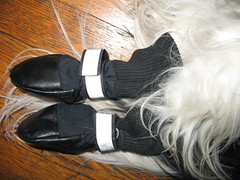
to fortify the spirits of persons who are tired of stuffing tiny little feet into tiny little boots.

If there is even the slightest possibility of snow, the building superintendents in our neighborhood coat the sidewalks with a thick layer of vile, chemically-enhanced salt. I complained to my own super about it once, and although he tends to forget basic English-language phrases when asked to schedule a repair, he managed to exclaim "but it's cheap!"

With any luck we're done with little boots for the season, and can move on to the spring-time task of toweling off little wet paws.

I rarely make desserts but February is such a drag that it seems appropriate for routines of all kinds to be broken, even the most banal, even the most domestic. So, dessert. I'd wanted to try this recipe for Aztec hot chocolate pudding since I'd clipped it from the NY Times in 2003 (!) because, as I mentioned once before, I find chocolate much more interesting when it's combined with some improbable flavor — chile powder or flowers, nothing too kooky.

This dessert looks a lot like a pan of brownies when you pull it out of the oven —

Aztec hot chocolate pudding


But notwithstanding the name, it is a variation on the ubiquitous "molten chocolate cake": fully cooked around the edges, gooey in the center. This one is flavored with a heady combination of cinnamon, chile powder and dark rum, and I loved it.

Aztec hot chocolate pudding


Here is the recipe as published, with notes from me in brackets.

Aztec Hot Chocolate Pudding

Published: October 15, 2003

Time: 45 minutes

Butter for greasing pudding dish
1 cup all-purpose flour
2 teaspoons baking powder
1/2 teaspoon baking soda
Pinch of salt
1 teaspoon ground cinnamon
1/4 teaspoon chili powder [I substitued cayenne and was pleased with the flavor]
1 cup superfine sugar
1/2 cup best-quality cocoa powder [I used Droste]
1/2 cup milk
1 teaspoon vanilla extract
1/4 cup corn oil
1/2 cup dark brown sugar
1/4 cup dark rum [I used a 4-year-old oak-aged rum by Rhum Barbancourt; it's made in Haiti and is, so far, the only rum I've tried that I truly like].

1. Heat oven to 350 degrees. Butter 8-cup pudding or soufflé dish. Set aside. In large bowl, combine flour, baking powder, baking soda, salt, cinnamon, chili, superfine sugar and 1/4 cup cocoa powder. In small bowl, mix milk, vanilla and oil. Pour into flour mixture. Mix by hand for thick smooth batter.

2. Spoon batter into pudding dish, and smooth the top. Pour 3/8 cup water into a small pan. Set over high heat, and bring to boil. In small bowl, combine remaining 1/4 cup cocoa with brown sugar, making sure there are no lumps. Spread evenly across the batter. Pour boiling water over it, and top with rum. [The batter will be a sloshy mess at this point; don't despair, it's supposed to look like that. Just avert your eyes and put it in the oven.]

3. Bake pudding until top is a bubbling sponge and center is wobbly and liquid, about 30 minutes. To serve, spoon out portions that include some of the top and chocolate sauce beneath. If desired, accompany with vanilla ice cream.

Yield: 4 servings [I disagree; this is a very flavorful dessert and a large serving is not ideal. This serves at least 6, and possibly even 8 if served with ice cream.]

Wednesday, February 14, 2007

Committee interrupts unscheduled hiatus to wish everyone a happy Saint Valentine's Day


A 1907 Valentine's Day menu from Dooner's Hotel, Philadelphia; image from the NY Public Library digital image gallery (Miss Frank E. Buttolph American Menu Collection).


May your own tiny banquets be festive and delicious. For this one day I won't say anything judgy about the wobbly heart-shaped splurts of raspberry coulis that adorn plates all over the nation in honor of the holiday.

We've been too busy as of late to even read blogs much less update this one; after you've read this little greeting why not check out some of the lovely blogs I link to in the column over on the right-hand side there?

xoxoxo,
TBC

Friday, December 29, 2006

Committee returns from hippie Christmas; probably totally smells of patchouli

Our Christmas wasn’t what I’d had in mind, for several reasons:

I didn’t count on taking off without wishing all of you happy holidays, but the advertised “high speed internet” at our rented cabin eluded me.

The “fireplace” was a wood stove with glass doors that hadn’t been cleaned since ever, and because the catalytic converter was broken we had to feed it hunks of wood every two hours rather than every twelve.


The “fully equipped kitchen” consisted of four propane-fueled burners and the saddest little toaster oven I’d ever seen. Four burners sounds promising, but they were feeble, they might as well have been powered by Fred Flintstone’s feet; it took an hour to boil water for pasta.

The “terrific claw-foot bathtub” had a shower-head attachment, but only persons 4' tall or less would be able to wash while standing; we are a little taller and it was like bathing in a bucket.

The “work of numerous local artisans” touted by the owner is best represented by the unique piece below, which was hung in the pantry (apparently on account of her curious sense of modesty).

uhhhhh . . .

What do you mean you're not familiar with the mythic vajayjay bird?


Then there was this, which I call "Minge Panic."

minge panic


There was also a deer pelt room divider (four deer skins!) that freaked us out a little bit.

a corner of the cabin we rented


We nonetheless managed to have a pleasant holiday. It was far too warm and unsnowy for cross-country skiing so we went for a hike at the Tivoli Bays nature preserve.

Christmas Eve hike at Tivoli Bays


We accidentally wandered off the trail — it was covered with leaves — and exited the preserve at Bard College rather than at the entrance where we'd parked the car. Below is the college's rather spectacular Fisher Performing Arts Center, designed by Frank Gehry.

Fisher Performing Arts Center, Bard College

You can see more of the building here.


We found our way back to the car without any help from the locals; thanks again Mr. Runs-back-in-his-house-at-sight-of-unarmed-strangers-in-driveway.

Our Christmas Eve truffled chicken could not be cooked in the toaster oven; some of them are large enough to roast a small chicken but the one at the cabin was suitable only for toast for two. I suppose it's just as well; my planned menu had already been scratched due to capricious last-minute shopping. We decided to simply pack up the car and stop by Gourmet Garage to fill our cooler on our way out of town, and they didn't have truffles; I picked up a nice-looking chicken and a small tub of D'Artagnan's white truffle butter instead, plus a few other staples. (More on this tomorrow; I think it's important to bring a few basics when you'll be cooking elsewhere for a few days).

Fortunately we were able to secure a reservation for Christmas Eve dinner at Madalin's Table, the restaurant at the Madalin Hotel in downtown Tivoli, or as close as one can get to "downtown" in a town too small for traffic lights. I did not realize until a bit of googling just now that the hotel was featured in a recent article in T, the New York Times travel magazine, although it hadn't yet opened at the time. The restaurant has since been reviewed in the paper as well.

Madalin Hotel, Tivoli NY


Madalin Hotel, Tivoli NY


Dinner was very good, notwithstanding that one of the owners was very cranky and didn't like the fact that we'd even been given a reservation; the policy apparently is reservations only for parties of 6 or more, and he wasted no time in letting us know about it. The other owner cheerfully brushed him aside and made sure we were seated promptly, and all was well.

The amuse-bouche of braised pheasant with a cranberry relish and finely-chopped almond could have used a bit more moisture, but our appetizer of cornmeal-dusted fried calamari was just right. I had a grilled shell steak and my friend had lovely crisp-skinned and juicy roasted chicken. We'd had champagne before we got there so I don't have further details about the food, sorry. I do remember that the coffee we had afterward was superb, the best I'd had in a long while; there were three or four choices on the menu, all single-origin beans roasted by Monkey Joe Roasting Co. of Kingston, NY. It was served in a french press and it was just perfect.

On our way home a couple days later we stopped at the Red Hook Village Diner, where a sign above the counter proclaims that the coffee is "Eight O'Clock brand." I remembered eating at this diner once years and years ago while visiting a friend at Bard; the breakfast isn't remarkable — at least, mine wasn't — but the diner itself, built in 1927, is charming.

Red Hook Diner


Red Hook Diner plaque


My scrambled eggs and bacon weren't memorable, but it is nice to be given a choice between homefries and hashbrowns, and to be served toast that's already buttered; I wish more restaurants did the same. Lunch or dinner here would at least be worth trying, and maybe dessert too; I noticed a big, homemade-looking cake under glass.