Thursday, July 26, 2007

we're back and I'm a little cranky about it

Vinalhaven-to-Rockland

Some of it is the usual vacation-is-over malaise; some of it is the sense that but for oppressive student loan debt, I'd like to live on the island for at least a year or two. I've lived in the east village for nearly ten years now and, particularly during this third visit to Vinalhaven, I've come to suspect I could be really, really happy there. I also strongly suspect that whatever bacon I would be able to bring home there would fail to satisfy The Student Loan People's voracious maw.

But! Of course the preceding two weeks were not marred by gloom.

We sniffed at pine-scented breezes.

sniffing

We ate superlative clam chowder, fried clams, blueberry pie.

clam chowder


fried clams


blueberry pie

The chowder, clams and pie above were from the Harbor Gawker, which happens to be for sale (scroll down). Any fantastically generous readers want to buy me a restaurant? I am smart enough not to tinker with their menu, nor alienate their super-friendly employees. And I'm a lawyer, which might come in handy if Rebecca Charles ever drops by.

We also ate plenty of fearsome creatures from the deep.

big bully

It's a bad season for lobstermen so far, and I understand last year was bad too, but the industry seems to be a sustainable one.

blue Maine lobster


steamed Maine lobsters


lobster rolls

We found a SPOOKY hidden graveyard in the woods.

hidden graveyard

We admired spindly, celadon green mosses and pearly seaweed.

spindly moss


Geary Beach park

It rained A LOT.

it rained a lot


Lane's Island on a cloudy morning

And it was foggy A LOT.

Geary Beach park


foggy Mill Creek

On the sunnier days, we drove around with all the windows open.

driving to town

Or we sat on the deck and watched for the birds: osprey, herons, the occasional bald eagle.

Mill Creek on a sunny afternoon


yes, that's Mill Creek again

I fell in love with moths and yellow spiders.

fuzzy moth


hairy moth


another yellow spider


luna moth

This preposterous fuzzy-headed creature in the faux bois style — a luna moth — alit on our door the morning of my birthday. He seemed determined to stay for a while so we moved him to a rock nearby, for fear that he'd be trampled by the guys coming to work on the hot water heater. He didn't move for a very long time, even after a breeze knocked him off the rock and onto the deck, and my mind rattled with plans for his florid little corpse: I didn't have a shoe box but I had a plastic container about the right size to transport him to Manhattan, and then he'd probably need to be sprayed with some sort of preserving tincture, wouldn't he, and maybe I ought to see about having a professional mount him in a little glass case, and wouldn't that be the most memorable birthday gift to myself? The little beast did not expire after all; he was only resting, and flew away before the morning was over.

Another one came by the next morning, and stayed until his impressive antennae were dry.

luna moth trying to dry after the rain

I'm still unpacking but hope to be posting recipes for lobster rolls and whatnot soon.

Carver's Harbor

Saturday, July 07, 2007

Committee adjourns for summer recess until July 22nd

For weeks I've increasingly found myself longing to be on Vinalhaven now, reminded, on a daily basis, of my love for the place by some sensory fragment or other.

On my way to work one recent morning, a problem with the F train compelled me to get off one stop before my usual one and walk up 6th Avenue. As droplets from the spray of the many fountains landed on my face, scattered by the wind, I could think only of how much I'd rather be on the ferry, passing by those first outlying islands so crowded with pines.

goodbye, islands!


On my way to the wine store another day I noticed a new ice cream shop in my neighborhood; I contemplated going in but it just couldn't taste as good as it does after an early morning hike on one the island's trails.

MCHT trail sign


maple-walnut ice cream


And on mornings when I've walked the dog and struggled to keep him from snacking on the discarded chicken bones and pizza crusts littering the sidewalk, I thought of how much nicer it is to take him for his morning walk at the Lane's Island nature preserve, where the only thing he'll get to nibble on is the occasional found blackberry I'm willing to share.

morning walk


Lane's Island nature preserve


A NOTE ON COMMENTS Please be patient if you leave a comment on any of my posts while I'm away; it won't appear on the site until I've approved it, and I may not be able to do that until I get back from vacation!

Thursday, July 05, 2007

there is zhough in everything

It's all gone now, but during one recent week the Yemeni spice paste zhough wound up in just about everything in the Tiny Banquet kitchen. Early one morning I crushed a pile of chile peppers, spices and herbs to a pulp with a mortar and pestle—not an effortless task, but fortunately I had plenty of coffee before I got started—and voila, the result was a generous quantity of spicy, delicious, vivid green zhough.

making zhough


The recipe below comes from Deborah Madison's Local Flavors: Cooking and Eating from America's Farmers' Markets. Too often I buy a new cookbook and excitedly flag the most appealing recipes with post-it notes, only to put the book away without trying any of them. That's exactly what I did with Local Flavors, unfortunately. Sometimes it happens because I've only just discovered a book during the wrong season (like when I stumbled across Claudia Roden's Everything Tastes Better Outdoors one miserable February), but there are interesting recipes for every season in this book. I wish I could say I prepared an entire meal from it, but so far I've only gotten to the zhough.

I was intrigued by Madison's suggested uses for it: "A chile paste from Yemen with a hint of sweet spice, zhough can be spread on pita bread or stirred into vegetable stews, soups, and sauces. Try it with grilled sweet potatoes or whenever you want extra heat and spice."

Madison explains that "[y]ou can use jalapeños, serranos, Anaheims, poblanos, or perhaps another chile that grows in your area. I usually use jalapeños with 1 serrano thrown in for extra heat and flavor." I only had serrano peppers, which can be quite a bit hotter than jalapeños, so I used only half the amount of them. 2 ounces of serrano peppers, if you were wondering, looks like this:

serrano chile peppers


I was pleased with the level of heat; the paste was spicy, but not painfully so.

Green Chile Paste (Zhough)

4 ounces fresh green or red chiles [see comments above]
1 teaspoon black peppercorns
1 teaspoon cumin seeds
1 teaspoon caraway seeds
1/2 teaspoon ground cardamom
1/2 cup coarsely chopped parsley
1/2 cup coarsely chopped cilantro
4 garlic cloves, peeled and chopped
olive oil to moisten
pinch sea salt

1. Remove the seeds and veins from the chiles, chop by hand or in a food processor and set aside. (If using food processor, stand back—the volatile oils can be irritating.)

2. Crush the peppercorns and spices in a mortar. Add the chopped chile, parsley, cilantro, and garlic and continue to work to make a smooth paste. Add oil to moisten—the zhough should have a paste-like consistency—and a pinch of salt. Keep refrigerated and use within a few days.


I was initially afraid I wouldn't be able to use all my zhough but I ended up using every last spoonful. The first dish I made with it was possibly my favorite: I rubbed about two tablespoons of it underneath the skin of a chicken breast, and roasted it as usual.

roasted chicken breast with zhough


It smelled fantastic, and the spice paste kept the meat juicy. I particularly enjoyed the flavor of the caraway and I regretted than I hadn't made an entire chicken this way.
If you want to try this, use your fingers to gently separate the skin from the meat, and evenly distribute about a tablespoon of the zhough underneath the skin on each side of the breast (or a bit less if your chicken is in smaller pieces; I'm sure this would be good with chicken thighs or legs as well). Rub the outside of the skin with a bit of olive oil or softened butter, season it with salt and freshly ground pepper, and roast as usual.

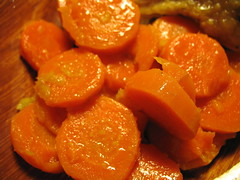
On the side we had braised carrots with galangal, which was inspired by Marcella Hazan's simple (but precise) method of cooking carrots, which you can read about here. It sounds like it requires you to pay an inordinate amount of attention to your carrots, but it's not labor-intensive and the results are worth it. To make them with galangal (or fresh ginger) rather than Parmesan, simply add a tablespoon of grated or minced galangal (or ginger) to the pan along with the salt and the sugar, and omit the cheese.

I also want to mention something we ate before the chicken, because it was so good and I know I won't manage to fit it into another post: remember the za'atar I wrote about a couple weeks ago, in my scallop post? It is amazing in deviled eggs, and fun to eat. When was the last time you ate deviled eggs? Possibly years ago, right? I am definitely going to make these more often because the za'atar was so good with them, and it's not even necessary to make it in advance: simply stir a little fresh thyme and toasted sesame seeds into the egg yolk mixture (you only need a tiny bit of mayonnaise, more for texture than for flavor), and sprinkle a pinch of sumac on top after you've spooned the yolk mixture back into the egg whites. If you have any interest in assembling a vaguely-Middle-Eastern picnic, this is the perfect food to start with.

Returning to the zhough, my second-favorite use for it was stirred into chickpeas. Canned chickpeas are ok for this; just rinse them well under plenty of cold running water, drain them well, and pat them dry. Heat a tablespoon of olive oil in a sturdy pan over medium-high heat, add the chickpeas and cook until they are heated through and beginning to brown, and stir in a rounded tablespoon of zhough, or a little more or a little less, to taste. That's it. Chopped fresh parsley or cilantro is nice, but not necessary. If you have some good plain yogurt, a spoonful would be nice on top. These chickpeas as good at room temperature as they are warm, something to keep in mind if you are considering a vaguely-Middle-Eastern picnic.

chickpeas with zhough


I used the rest of the zhough to marinate some shrimp, which I broiled and served on top of a simple green salad dressed only with olive oil and lemon juice.

broiled shrimp with zhough


salad with broiled shrimp


They were good but not as good as the chicken, and I think the reason was their brief time under the broiler. Shrimp of this size need to cook only for about 3 minutes, but the heat mellowed the zhough's spiciness more than I expected. If I make these again I'll set some of the zhough aside and use it to make a dressing for the cooked shrimp.

Monday, July 02, 2007

the portable kitchen

topographic map of the island


We reserved our customary crumbling hippie shack on the island of Vinalhaven, Maine for two weeks in July and suddenly it's time to start thinking about what to bring.

Did you happen to read Cynthia Zarin's "Fantasy Island" in last August's Gourmet supplement, about the challenges of cooking in a rental on a small Maine island? Zarin was writing about Swan's Island but her description of the sad little grocery store reminded me of the one on Monhegan Island, which we visited several years ago:

The owner of the cottage had left a map marked with the location of the grocery store and the historical society. (Later I was to reflect that these were, in some respects, one and the same). We piled into the car, still packed with our swimsuits and summer reading, our towels and orange peels. A few minutes later, I stood in front of the vegetable bin, which contained three molting cabbages and a few wormy potatoes. Too late, I read the message of those grocery bags on the ferry. Dismay hit. What would we eat?

Fortunately the author's neighbor on the island turned out to be a lobsterman amenable to bargaining, but after five days of boiled lobster, sautéed lobster, grilled lobster, and lobster salad, "[t]he children had recoiled from lobster's waving tentacles, its garish red hue, and by Thursday, so did we."

I'm hesitant to tell anyone, but the situation on Vinalhaven is much more agreeable. There's a small but well-stocked grocery store (Carver's Harbor Market, shown below), and an even-smaller but also well-stocked store across the street (Island Spirits) that sells wine, cheese, olives, bread from Atlantic Baking Co. on the mainland, and good coffee.

Carver's Harbor Market

The Victorian-style house to the right of the post office belongs to the artist Robert Indiana.


Many (most?) of the island's year-round residents are lobstermen, and at the Vinalhaven Fisherman's Co-op — just down the road from the grocery — you can choose a vivacious local lobster from the tank while you put gas in your car.

It's hard for me to get used to thinking about food shopping in advance when at home I pass by so many grocery stores and markets on foot every day, but my vacation cooking tends to be improvisational, and a forgotten bundle of chives or whatever can always be worked around.

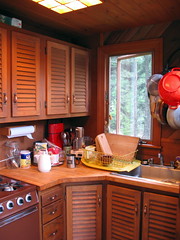
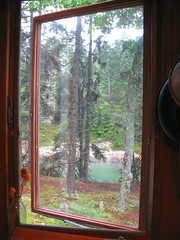
We're fortunate with respect to the kitchen at the cabin. It's small, but so is the one in my apartment and this one's got a nicer view. It's also unusually well-equipped for a summer cabin kitchen: there's a full-sized food processor, a coffee/spice grinder, decent pots and pans (plus a few pieces of Le Creuset, which are more than decent), sharp knives, and the lobster crackers and their accompanying picks and forks and butter cups are all accounted for.

Nonetheless, I bring a box of kitchen must-haves, and over the past couple years I think I've refined my packing list to the point where I'm bringing only things I know I'll end up using. Of course much of the list that follows is a matter of one's cooking style and preferences, but I hope it will be useful to those of you who will have occasion to take your batterie de cuisine on the road this summer:

the Tiny Banquet portable kitchen (summer edition)

gadgets:

  • kitchen shears

  • timer

  • tongs (there are probably some there but I can't remember, and can't deal with two weeks without them)

  • favorite corkscrew

  • muslin (for straining seafood shells out of stock)

  • twine (for who-knows-what)

  • pastry blender (it's definitely not too hot to bake there)

  • biscuit cutter

  • lemon reamer

  • tiny strainer (am I the only person who finds these indispensable?)

  • tiny whisks (like these; I know they look ridiculous but I use them constantly for making small quantities of salad dressing)

  • small Kyocera ceramic slicer (like this)

  • microplane grater

  • silicone basting brush

  • small silicone spatula


spices

  • peppermill and plenty of peppercorns (Malabar)

  • flaky sea salt

  • smoked salt

  • Aleppo pepper (a flavorful red pepper from Syria)

  • Pimentón de la Vera (hot Spanish smoked paprika)

  • cayenne pepper

  • coriander seeds

  • cumin seeds

  • cardamom seeds

  • fennel seeds

  • whole nutmeg

  • five-spice powder (a versatile blend of star anise, cinnamon, clove, fennel and white pepper)

  • Old Bay seasoning

  • saffron


cookware

  • silicone muffin pan (in anticipation of Maine blueberries)

  • small cast iron skillet (9") (the pans at the cabin are all larger, and this one is my most-used pan at home)


grilling paraphernalia: I know the grill there is rusted and unusable. I'm bringing a small charcoal grill this year, and they require a few accessories.

  • wire brush for cleaning

  • chimney for starting charcoal

  • hardwood chips

  • bamboo skewers


condiments & etc.

  • favorite olive oil

  • Vinagre de Jerez Sherry vinegar

  • Champagne vinegar

  • Maille extra-hot Dijon mustard

  • Kewpie mayonnaise

  • salt-packed capers

  • good imported tuna in olive oil

  • pine nuts (why is it that in many places they seem to be sold only in tiny, overpriced jars?)


grains and such

  • good dried pasta

  • good polenta

  • chickpea flour

  • de Puy lentils

  • Calasparra rice


It's a lengthy list, I know, but most of these items are small. At least, that's what I tell myself.

I didn't include cookbooks on my list, for a few reasons: (1) as I mentioned above, I don't often cook from recipes while we're there; (2) there are a few cookbooks at the cabin in case I'm stuck on making something I can't improvise (the most useful seems to be a giant Craig Clairborne book, as big as a dictionary); and (3) I've got lots of recipes in my laptop, stored in MacGourmet. I've also got lots of newer recipes in my del.icio.us, but there's no internet at the cabin, so I'll have to go through and see if there are any I have to add to MacGourmet before we leave.

Think I've forgotten anything important?

Monday, June 25, 2007

Chicken satay with no national allegiances

I had some chicken thighs that needed to be cooked, a new bottle of kejap manis, the Indonesian sweet soy sauce, and, I thought, a nice big piece of galangal, a ginger-like root I've recently become crazy about. Perfect for chicken satay with peanut sauce, right? The galangal, much to my dismay, had grown a healthy coat of mold since I'd seen it last and had to be thrown away, but by the time I realized this I was determined to have satay for dinner.

I consulted several recipes, including chicken skewers with nuoc cham (Food & Wine), gingery chicken satay with peanut sauce (ditto), Balinese chicken satay (Martha Stewart), beef satay (Chez Pim; a different meat, but peanut sauce does not discriminate), and pork satay with an appealingly simple marinade (Bon Appétit). I didn't end up following any of them; instead I improvised a recipe using what I had on hand. The result was a delicious satay that was a little Indonesian (by way of the kejap manis), a little Thai (by way of Golden Boy fish sauce — the radiant baby is my new favorite kitchen icon), and a little Balinese (by way of the coconut). I wouldn't present it to anyone as an authentic rendition of the cuisine of any of these cultures, of course, although it would be loads of fun to put together a comparative satay menu someday, wouldn't it?

Golden Boy fish sauce

Adding plenty of fish sauce to the marinade for your satay will give you a radiant, youthful glow.


There is no one right way to make satay. There's not even one way to spell it; in some places it is saté, and in South Africa it is sosatie. According to The Oxford Companion to Food, satay is

a dish of SE Asia, especially Indonesia, Malaysia, and Thailand, which consists of small strips of meat, chicken, or fish threaded on to thin skewers . . . . Marinades vary from place to place but typically include dark soy sauce with lime juice, sugar, garlic and other seasoning. The common accompaniment for satay is a dipping sauce based on peanuts, pale brown in color. But other sauces may be used.

The entry goes on to quote Jennifer Brennan's Encyclopaedia of Chinese and Oriental Cookery on the origins of satay. Although it's often regarded as Indonesian, it did not spring up in Indonesia in a singular moment of genius:

Although both Thailand and Malaysia claim it as their own, its Southeast Asian origin was in Java, Indonesia. There satay was developed from the Indian kebab brought by the Muslim traders. Even India cannot claim its origin, for there it was a legacy of Middle Eastern influence.

A few comments on the recipe that follows: First, the only thing kecap manis has in common with ketchup, apart from the sound of the name, is that it comes in a bottle. I recommend picking up a bottle the next time you see one because it's got great flavor and a very nice texture - thick, smooth, glossy - but it is basically a sweet soy sauce, and you can substitute a mixture of soy sauce and brown sugar if you don't have it. (A low-sodium soy sauce would be preferable because the fish sauce will add plenty of salt to the recipe). Second, there isn't really a satisfactory substitute for fish sauce, and it's easy enough to come by (and versatile enough to be used up before it goes bad), so you might as well buy a bottle. Third, I used dried lemongrass, and I don't feel too bad about it - I'd rather use that than have woody bits of past-its-prime fresh lemongrass stuck between my teeth. If you have 2 stalks or so of tender fresh lemongrass, by all means use it, but if all that's readily available is dried-out and sad looking, use the dried stuff. Finally, I used light coconut milk. I do feel sort of bad about that because the flavor tends to be insipid, but have you looked at the fat and calorie content of regular canned coconut milk lately? There are some high calorie foods one can compromise on without suffering too badly, and for me coconut milk is sometimes one of them: I find it acceptable, for some recipes, to boost the flavor of light coconut milk with a spoonful or two of shredded unsweetened coconut. For a good curry, only the full-fat type will do, but for a marinade this mixture is a decent compromise.

chicken satay


I'm hesitant to suggest how many people this serves because it can be a first course or a main course or, for the industrious, a snack to have with drinks. Let's say it serves 3 to 6 people.

chicken satay with peanut sauce

1 1/4 lb. boneless, skinless chicken thighs, trimmed of fat and cut into strips suitable for threading on skewers (about 1 1/2" wide)

marinade:
2 serrano chiles, seeds and ribs removed, coarsely chopped
2 cloves garlic, peeled and chopped
1 heaping tbsp. shredded unsweetened coconut
1 heaping tsp. freshly toasted and ground coriander seeds
1 heaping tsp. grated fresh ginger
1 heaping tsp. powdered lemongrass (see comments above)
3/4 cup coconut milk (see comments above)
1 tbsp. kejap manis (substitute 1 tbsp. low-sodium soy sauce + 2 tsp. dark brown sugar)
2 tbsp. fish sauce
peanut oil for brushing pan or grill

peanut sauce:
1 tbsp. peanut oil
2 small cloves garlic (or 1 large), minced
1 heaping tsp. freshly toasted and ground coriander seeds
1 tbsp. shredded, unsweetened coconut
3/4 cup coconut milk
1/3 cup natural peanut butter
1 tbsp. kejap manis (see note above regarding substitute)
juice of 1/2 a lime
fish sauce, to taste

accompaniments:
crisp lettuce leaves
wedges of lime
chopped cilantro
coarsely chopped dry-roasted peanuts

equipment:
wooden skewers, soaked in water for 30 min. before ready to use
a broiler pan, a cast iron grill pan or a bbq grill

To make the marinade, put the chiles, garlic, shredded coconut and spices in a food processor and mix at full speed until they start to form a paste. Add the coconut milk, kejap manis and fish paste and mix until thoroughly combined. Put the chicken pieces in a large ziploc bag or shallow dish and pour the marinade over them. Marinate, tightly covered, in the refrigerator for at least 5-6 hours.

For the peanut sauce, heat the peanut oil in a small sauce pan over medium-high heat and sauté the garlic, the coriander, and the coconut until the garlic softens and the coriander and coconut are browned and very fragrant. (This will take just a minute or less). Add the coconut milk and bring to a boil. Stir in the peanut butter and the kejap manis until the sauce is smooth and remove the pan from the heat. Once the sauce has cooled down a bit, stir in the juice of half a lime and season to taste with the fish sauce. (I was happy with just a sprinkle of fish sauce, and added a pinch of salt as well; keep in mind that you won't be able to accurately taste for seasoning while the sauce is still very warm, and you can always add more later). The sauce is best made ahead of time and refrigerated; bring it to room temperature before serving.

Take the chicken out of the refrigerator approximately 15 min. before cooking. Take the skewers out of the water, pat them dry, and thread the chicken on the skewers. Brush a broiler pan, grill pan or bbq grill with peanut oil and broil or grill the chicken approximately 6-10 minutes, turning once during cooking. (The cooking time will depend on the thickness of your pieces of chicken; the juices should run clear, and if you're in doubt about whether the chicken is cooked through, cut into one of the thicker pieces and have a look at the inside).

Serve the skewers warm or at room temperature on plates lined with lettuce leaves, and sprinkled with chopped cilantro and chopped dry-roasted peanuts if you like. The sauce is most flavorful served at room temperature and can be either drizzled over the chicken or served in cups alongside it.

unphotogenic accompaniments to chicken satay


The peanut sauce is unphotogenic, as is the red cabbage, carrot and radish slaw I made. The delicate little cucumbers I picked up at the farmers' market yesterday morning, however, were gorgeous and needed nothing more than a sprinkle of coarse salt.

two types of cucumber

Lemon cucumbers and young Persian cucumbers.


fancy!

The interior of a lemon cucumber.


The recipe for the slaw needs to be refined, I think, but I'm posting the recipe anyhow because I think it's worth experimenting with. Most coleslaw recipes contain sugar and I think using kejap manis in its place is worth a try; it adds a subtle sweetness and it has a depth of flavor that white sugar lacks, almost like a savory, salty caramel. I used only red cabbage because that's what I had, but I think a mixture of green and red would look nicer and would have a more pleasing mix of textures. The recipe below makes more dressing than needed; the excess will keep in the refrigerator for a couple days in a tightly-covered container.

Red cabbage, carrot and radish slaw

2 tablespoons toasted sesame oil
juice of 1 lime
1/2 tsp. Sriracha sauce (red chile and garlic sauce), or more to taste
1 tbsp. kejap manis
1 tbsp. mayonnaise (recommended: Japanese brand Kewpie)
12 oz. red cabbage, shredded (see comments above)
1 carrot, peeled and shredded or sliced paper-thin
2 large red radishes, sliced paper-thin
2 tablespoons dry roasted salted peanuts, coarsely chopped

Whisk together the sesame oil and lime juice until emulsified and then whisk in the Sriracha sauce, the kejap manis and the mayonnaise. (Dressing can be made ahead of time and stored in the refrigerator in a tightly-sealed container).

Just before you're ready to serve the meal, toss together the cabbage, carrot and radishes with enough dressing to moisten them. Toss in the chopped peanuts, if using, and serve at once.

There was a dessert too, and it didn't quite work out. I thought it would be clever to make a sort of dessert spring rolls with blueberries and the filo dough I had left over from another recipe (coming soon in its own post), and I also thought it was quite possible that the filling would leak out during baking. I tried to prevent this by stirring a mixture of cornstarch and lime juice into the blueberries, with hopes that the juices would thicken and stay put, but I ended up with a bubbling blueberry puddle on my baking sheet. Fortunately I lined the baking sheet with parchment paper rather than a Silpat (I didn't want to have to scrub a sticky mess), and fortunately the results were quite edible anyhow. They just didn't have much filling on the inside.

a dessert that didn't quite work


What was left of the filling had a terrific flavor, and I'm going to use it again to fill something a little more sturdy before the summer's over: 1 pint of blueberries tossed with 2 tablespoons of turbinado sugar, plus 1 tablespoon of cornstarch that had been whisked together with the juice of half a lime until smooth, plus a generous pinch of cinnamon. It deserves a decent pastry shell.

Monday, June 18, 2007

a new favorite cooking show

I learned of Andreas and Christina Theodoulou on Ananova, which reported that "[a]n elderly Cypriot couple from London have become an unlikely internet hit with their cookery videos," which are shot, edited and uploaded by their son, Orthodoxos.


You can watch more of their videos here.

If you are not familiar with Ananova, by the way, it's handy for catching up on news about sulking old Serbian ladies, cannabis-munching Swiss cows, and the latest trendy pets in Japan.

Tuesday, June 12, 2007

Committee descends into frittata madness

Frittata, constantly cooking in my cast iron pan, clarifier of my conscience. My kitchen guilt, my reluctance to rid my refrigerator of the remains of last week's farmers' market reverie. Free-tah-ta: the ragged, rapidly decomposing tops of radishes will make themselves at home in a radial swirl on your surface, a relief map of greens I brought home in a rather more fresh state, oh when? Could it have been a week ago? They'll be resuscitated with a rounded spoonful of ricotta cheese. Free. Tah. Ta. Ready recipient of any resourceful cook's remnants.

My apologies to Mr. Nabokov, who hopefully would have laughed at the sight of his prose — an enthusiastically scrambled tribute to it, at least — being retrogressively used to prod readers into cooking more rustic egg dishes. On a blog, at that.

There are several reasons to appreciate the frittata, the first being its ability to accommodate disparate vegetables hiding in corners of the refrigerator, an end of cheese reduced to a small pile of gratings, a single cold steamed potato, even half a cup of cold pasta that would otherwise be thrown away. In my experience, the longer one cooks, the greater one's pleasure in being thrifty, in not letting things go to waste. Particularly if one had plans for the produce in question — a bag of mixed lettuces that had been destined for a soufflé, until the Gruyère that was to stand in for the Cheddar accidentally got eaten, or a prodigious bundle of parsley that was to be used for a pot of green butter, which was in turn to be used to make little sandwiches. All of these things can go into a frittata, and the end result may be as harmonious as if you'd planned to use them for that purpose all along.

The second reason to appreciate the frittata is its versatility. It's great served warm from the oven, but just as nice at room temperature or even cold the next day. It can be cut into bite-size cubes and served as a snack with drinks, or it can be sliced and draped over a salad, or made into a sandwich.

The Silver Spoon, which has been referred to as "the Bible of Italian cooking" so often that my fingers type those words on their own, has, of course, instructive advice on frittatas. For starters, I had the plural wrong:

Italian omelets — frittate — are economical and quick and are among the tastiest dishes that can be made with eggs. They are also very versatile, as the basic recipe may be enriched and flavored with a wide range of other ingredients, including herbs, vegetables, fish, cheeses, salami, ham and fruit. As regards quantities, in general allow two eggs per person if the frittata is served as a main course and one if it is an antipasto. As a general rule, 1 1/2 teaspoons butter or olive oil is required to cook every two eggs.

The Spoon contemplates frittate thin enough to be flipped in the pan, and cooked on each side for just 1-2 minutes (or "2-3 minutes if there are more than four eggs"), but there are as many ways to prepare a frittata as there are cooks. If you are only using a few eggs, sure, flip it over in the pan, but if you are making a frittata that is more substantial, with half a dozen eggs or more and a pile of greens or who-knows-what, you must decide how to cook it through: Do you want to begin cooking it on the stove top and end with baking it in the oven, or do you want to mostly cook it on the stove top and just brown the top under the broiler? Are you determined to bake it in the oven for the duration of cooking? I've never tried the latter method and would be afraid it would dry out, since a frittata lacks the rich measure of cream that allows quiche to survive a long baking. I tend to make large frittate with 6-7 eggs and my method of choice depends both on what else I have cooking and what I've stirred into the eggs: If I have the oven heated up to 350-400°F for some other dish, I'll likely cook the frittata for 5-10 minutes on the stove, stirring occasionally with a wooden spoon or silicone spatula during the first two minutes to evenly distribute the ingredients, and then put it in the oven for approximately 10 minutes, or until it's set (i.e., no longer liquid in the center). If my frittata has grated cheese on top rather than stirred in with the other ingredients, I'll likely cook until it's almost set on the stove top, scatter the cheese on top, and put it under the broiler for just a minute. More often than not I use a method very similar to the scramble-and-broil method described by Pim (of Chez Pim) in this post, but I heat the olive oil over high heat and then do my almost-scrambling over medium or low heat, particularly if my ingredients are already warm or hot — adding just-sautéed greens, or crumbled and browned sausage, or any other ingredients that haven't cooled down will speed up the cooking time by a minute or two, and it's better to err on the side of undercooking rather than overcooking the eggs. You can always put the frittata into the oven for more cooking if you go to cut it and find that it's disconcertingly squishy under your knife. It should be firm but springy when it's done.

There's a way of flipping the frittata by inverting it on to a plate, but you've got to be sure that you have just the right size sturdy plate clean and ready to go at the crucial moment, and that you have two oven mitts handy, and what will you have gained? A cold oven. Useful on a hot summer afternoon, or if you are cultivating the carbon footprint of a saint, but otherwise it's hard to see what the advantage of that method is.

I was going to give four or five recipes for some of the best frittate we've had recently, but I didn't measure the ingredients for any of them. I never do. So, I'm just going to give you suggested combinations, followed by one recipe for what would be my favorite frittata of all, if it were a frittata and not a kuku.

golden frittata


Ramps, spring garlic, scallions, feta cheese Despite my remarks above about the virtues of ransacking the refrigerator for bits of this and that, the best frittate are premeditated to some degree, hopefully while buying the eggs at the farmers' market. I wanted something special for a frittata made with the Araucana eggs I'd picked up, and I set aside bundles of the last ramps of the season, green spring garlic, and a few scallions (green onions), and 3-4 ounces of crumbled sheep and goats' milk feta cheese. I chopped the bulbs of the ramps and the spring garlic and sautéed them in a couple tablespoons of olive oil until they softened, added the chopped greens from all three alliums and sautéed them until they wilted, then added six eggs beaten with the cheese, salt, pepper and a bit of freshly grated nutmeg, and cooked as described above. The result was a golden frittata filled with a fragrant tangle of greens and soft, flavorful cheese.

frittata innards


asparagus, mint and tarragon frittata


Asparagus, mint and tarragon There is something about the combination of eggs and mint that I can't imagine tiring of. Both mint and tarragon are strong flavors but somehow this worked. The asparagus can be steamed, blanched, or roasted as long as it is tender but still crisp. I chopped the asparagus into bite-sized pieces but if you have more patience for adorning your frittata you could neatly arrange the whole spears on the surface before it sets in the center.

artichoke heart frittata


Artichoke hearts, red onion and rosemary I used artichoke hearts canned in water, which I rinsed under cold water and patted dry. You've got to be mindful about not adding too many wet ingredients to a frittata; otherwise it won't cook properly. For this reason, I tend to stay away from tomatoes unless they've been slow-roasted or otherwise dried out, or unless they're firm plum tomatoes. Once the artichoke hearts were reasonably drained, I chopped them into bite-size pieces and sautéed them, with chopped red onion, in a few tablespoons of olive oil until they started to brown. I added a tablespoon or so of chopped rosemary, then the beaten eggs, and cooked as described above.

dandelion greens dandelion green frittata


Aburana with grated Kashkaval cheese Kashkaval is a Bulgarian sheeps' milk cheese with a mildly tangy flavor. I thought it would pair nicely with the greens, which I found at the Japanese grocery in a bag labelled "Aburana." I thought they were dandelion greens but my Googling thus far indicates only that they might have been some type of rapini. I sautéed the greens in olive oil (with a sliced shallot and some red pepper flakes, if my memory is correct), added the eggs, and then added the grated cheese on top when the eggs were almost set; it melted nicely, and fast became crisp and browned under the broiler.

dandelion green frittata


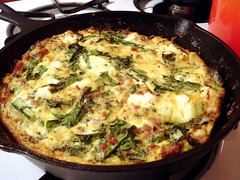
Kuku-ye Sabsi (pictured below) is an Iranian frittata-like dish traditionally made on New Years' Day. It's loaded with herbs, and the vibrant green color reflects hope that the year ahead will be a prosperous, happy, healthy one. I'm crazy about it and make it throughout the year, in the spring and summer with as varied a mix of herbs as possible, and in the winter with spinach and parsley and cilantro. The recipe below is from Claudia Roden's New Book of Middle Eastern Food. There's a similar recipe in the Boston Post which calls for currants rather than raisins; my guess is that in Iran it would be made with currants but they're not always easy to find, and it's great with raisins too. Roden indicates that the walnuts and the raisins are optional but I urge you to try the recipe with both, even if you are not a raisin person. I'm not, but the frittata that set me on the path to my frittata-enamored madness, years ago, was made with tuna and golden raisins and who-knows-what-else. I ate it at a tiny café in Lisbon on my way to Saint George's Castle, and I probably never would have ordered it had they had anything else to serve me but it turned out to be one of the most memorable lunches I've ever had.

Kuku-ye Sabsi
serves 6

6-8 eggs
4 ounces spinach, shredded
8 scallions, chopped
1/2-2/3 cup mixed chopped fresh herbs
[In the note preceding the recipe Roden says "Any favored herbs, such as flat-leaf parsley, dill, chervil, tarragon, chives and cilantro, may be used."]
3 tablespoons chopped walnuts (optional)
2 tablespoons raisins (optional)
Salt and pepper
2 tablespoons butter or vegetable oil

Lightly beat the eggs with the rest of the ingredients except the butter or oil.

Grease an ovenproof dish (about 10 inches) with butter or oil and pour in the egg mixture. Bake in a preheated 325°F oven for 45 minutes, covering the dish for the first 25 minutes, until the eggs are firm with a golden crust on top. Alternatively, cook the kuku in a large preferably nonstick skillet. When the eggs have set on the bottom, brown the top under a hot broiler.
[See my comments above for more details on this method of cooking. - TBC]

Serve hot or cold as a first course, accompanied by yogurt.

kuku-ye sabsi


The best way to prepare the yogurt, in my opinion, is to start with good yogurt and set it to thicken in a sieve lined with a coffee filter, perched inside a bowl to catch the drips. (If you're doing this several hours ahead of time, cover the whole set-up with plastic wrap and put it in the refrigerator). Once the yogurt is nice and thick, blend in some chopped mint or cilantro and a pinch of salt, and maybe a tiny bit of minced garlic. Very good on leftover frittata or with toasted pita.

The frittata pictured at the top of the post was made with puntarelle, turkey sausage and ricotta cheese. I posted a recipe for it last August, which you can read here.

Wednesday, June 06, 2007

a few words on scallops

Is there a season for sea scallops? Twice in the past couple weeks I've found terrific local ones from Long Island fisheries, first from from P.E. & D.D. Seafood (which I bought at the Union Square greenmarket), and then from Pura Vida Fishery, which started selling their catch at the Tompkins Square greenmarket for the first time (I think!) last Sunday. I linked to some photos of the P.E. & D.D. Seafood crew in my Memorial Day post but I couldn't find much information on the latter aside from a podcast interview with the captain and a few photos of their stand at another greenmarket last summer, and I was so excited to see seafood at the Tompkins Square market that I didn't think to ask whether they'd be regulars until I was nearly home with my bag of scallops. We are sorely lacking decent fish markets in the neighborhood, and the thought of being able to buy fresh local seafood a couple blocks from my apartment makes me very happy.

the depths of the ocean

The natural habitat of sea scallops looks something like this.


According to the Monterey Bay Aquarium Seafood Watch guide, bay scallops* and sea scallops are both generally fine choices in terms of sustainability and health. There are plenty of websites warning that "most scallops sold in the US" are treated with additives — specifically, with STP (sodium tripolyphosphate), which plumps them up and keeps them looking moist long after they would otherwise — but treated scallops are easy to spot and I haven't seen them sold that way in years. Then again, I live in the northeast, where both bay scallops and sea scallops are well-known and much appreciated. Let's have a brief tutorial, then, so you can take the appropriate course of action if you discover that a merchant in your area sells treated scallops: run them out of town, and agitate for them to be replaced with someone who cares about seafood.

The first tip-off that scallops have been treated with additives is if they're sitting in water. Both bay and sea scallops should be moist-looking and not the slightest bit dried out around the edges, but they should NOT be sitting in an inch or more of water. Or even half an inch. Aside from indicating that the scallops may have been treated with additives, a watery container means that a good portion of the price per pound would be, of course, water. Pan-seared scallops are good for dinner; pan-seared water, not so much.

The second (and equally-important) tip-off is the color of the scallops. Neither bay or sea scallops should be snowy white. They should be a creamy beige, or slightly pinkish, or tan, but never white. Look, I made you a visual aid:

scallop project


The colors are a little washed-out thanks to my bargain-basement scanner, but you get the idea.

Scallops have a reputation for being somewhat expensive but both of my purchases were $14/pound, roughly the same price or lower than the most in-demand types of fish, and roughly the same price as the ones I see in grocery stores, and who knows where those are from? Also, there's almost no waste with scallops; 99% of the ones sold in the U.S., whether at farmers' markets, fishmongers or grocery stores, need only to have the tiny, chewy ligament attached to their side removed before they are ready to cook.

don't eat this part

Don't eat this part; it's tough and chewy. Gently pull it off and throw it away. Don't freak out if your scallops are missing this part; your nice fishmonger already pulled it off for you.


I ended up pan-searing both of my recent scallop purchases, but other than that the two meals were very different; the first featured a beurre blanc lightened by the addition of plenty of tart sliced sorrel, and in the second the scallops were given a Middle Eastern flavor with a garnish of the spice blend za'atar. Here are the recipes:

Scallops with sorrel beurre blanc
Serves 2-4.

This recipe is an adaptation of this one from Food & Wine. The fact that the original recipe calls for bay scallops necessitated a couple of rather obvious changes: sea scallops are larger and need to cook longer than bay scallops, and because of their size it is easier to cook them evenly if they are seared on each side rather than stirred around to cook on all sides. And because I would be searing my scallops and turning them only once, it would not do to add the sorrel to their pan, where it might interfere with the browning process; better to add it to the beurre blanc instead.

I was planning to otherwise follow the recipe, but at the very last minute I realized that not only did I not have Champagne vinegar, I didn't even have 1/2 cup of white wine vinegar remaining in the house. I did, however, have 1/4 cup, and I had enough Grüner Veltliner in the refrigerator to keep the Tiny Banquet household happy for at least a couple evenings, so I used a mixture of the two. The resulting sauce was deliciously well-balanced and I'd proudly serve it to anyone.
A note on the portion sizes: Chef Vongerichten recommends 1 pound of bay scallops to serve 4. We had not eaten lunch and we ate an entire pound of sea scallops between the two of us. Obviously we are little piggies, although in our defense the rest of the meal consisted only of the fiddleheads I picked up at the greenmarket. If you are serving a first course you can certainly serve more than 2 people with these scallops. Unless they are hungry pigs.

Don't be discouraged by the fact that you'll have to clarify some of the butter; it only takes a few moments, and as I've mentioned in the past, there are important reasons for using it.

3 to 4 tablespoons cold unsalted butter, cut into tablespoons, plus 1 to 2 tablespoons clarified butter
1 medium shallot, minced
fine sea salt and freshly ground pepper
1/4 cup white wine vinegar
1/4 cup good white wine, preferably Grüner Veltliner (or something similarly mineral and citrus-y in flavor)
1/4 cup heavy cream
a pinch of cayenne pepper
1 pound sea scallops, tough ligament removed
1/2 cup tightly packed sorrel leaves, tough stems removed and finely shredded

Melt 1 tablespoon of the butter in a medium-sized skillet or shallow sauce pan over moderate heat. Add the shallot, season it lightly with salt and pepper, and cook, stirring, until it just begins to brown, about 1 minute. Add the vinegar and the white wine and cook, swirling the skillet over the heat, until the liquid is reduced to a couple tablespoons. Add the cream and bring it just to a boil. Add the remaining 2 to 3 tablespoons of butter, one piece at a time, while stirring the mixture with a wooden spoon; the sauce will thicken. (It will taste best if you add 3 tablespoons of butter, but if the thought horrifies you, you can get away with only adding 2). Stir in half of the sorrel and season the sauce to taste with the cayenne pepper and a bit more salt if necessary.

Meanwhile, heat the clarified butter in a heavy skillet (preferably cast iron) over moderately high heat. Add the scallops in one layer and cook approximately 10 minutes per inch of thickness, flipping them once during the middle of cooking. (It will be easiest to turn them if they are not crowded too closely together in the pan). Transfer the scallops to plates, spoon the sauce over them, garnish them with the remaining sorrel, and serve at once.

sea scallops with sorrel sauce

Scallops with sorrel beurre blanc.


The other recipe is very different but no less delicious. I first discovered the spice blend za'atar a few years ago in my beloved copy of Madhur Jaffrey's World Vegetarian; I'm not sure what drew my attention to such a brief recipe in such a big book, but somehow I decided I had to try it, and I fell in love with the flavor. There's a similar recipe for it in Claudia Roden's New Book of Middle Eastern Food because, unlike other Middle Eastern spice blends, za'atar (sometimes spelled zaatar or zahtar) is simple: it's only got four ingredients, maybe just three if you want it unsalted. According to Roden, za'atar is "wild thyme. It is also the name of the mixture of this herb with sumac, salt, and toasted sesame seeds. The mix, which is popular in Syria, Lebanon, Israel, and Jordan, is sold in little paper cornets to dip into with bread." It's great on all sorts of other foods, though; sumac is made of ground tart, red berries and like lemon, it brightens every dish it goes into. In colder weather I particularly like za'atar on roasted sweet potatoes. Now I know I love it on scallops, too.

sumac homemade za'atar


Any decent spice store will sell a pre-mixed version made with dried thyme, but it only takes a couple minutes to make your own with fresh thyme and the result is much more flavorful than any blend commercially available here.

Seared sea scallops with za'atar
Serves 2-4 (see comments above regarding portion size).

This recipe makes more za'atar than you'll need but it's not practical to make a smaller quantity, and it will keep well for a few days in a tightly-sealed container.

1 rounded tablespoon thyme, leaves only
2 rounded teaspoons sumac
2 rounded teaspoons toasted sesame seeds
coarse salt, to taste
1 to 2 tablespoons clarified butter
1 pound sea scallops, tough ligaments removed

Stir the first four ingredients together in a small bowl and set aside.

Heat the clarified butter in a heavy skillet (preferably cast iron) over moderately high heat. Add the scallops in one layer and cook approximately 10 minutes per inch of thickness, flipping them once during the middle of cooking. (It will be easiest to turn them if they are not crowded too closely together in the pan). Transfer the scallops to plates and sprinkle them generously with the za'atar. Serve at once.

seared scallops with za'atar

Sea scallops with za'atar. We ate these with some chickpeas flavored with a Yemeni spice blend called zhough, which is getting it's own post here soon.


* I don't see bay scallops around Manhattan often, but if you have an opportunity to buy them there is no reason to be snobbish about their comparatively diminutive size; some people prefer their flavor over sea scallops, believing them to be slightly sweeter.